

Covering news from 2 to 7 November 2026
Forwarded this issue? Latin American Rail Weekly is free each week: subscribe here
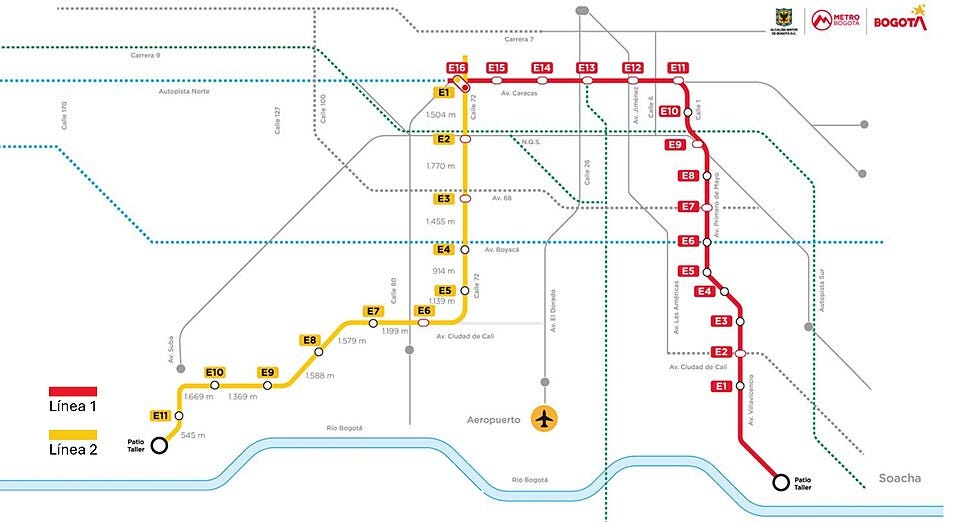
Image: Transparentar / Wikimedia Commons (CC0)
This week
In Colombia, three international groups, led by Mota-Engil, Xi’an Rail Transportation Group and Sacyr with CAF, have been prequalified for the Bogotá Metro Line 2 concession, with offers due at the end of the month. In Mexico, ATTRAPI has cancelled the tender for the San Miguel de Allende–Villa de Reyes lot of the Querétaro–Saltillo line and will build the first stage as single track with passing loops. In Argentina, the Belgrano Cargas bid date has moved formally to 21 December, with easier entry rules for bidders. Quito has completed the studies for a US$663m metro extension, and two federal approvals support São Paulo rail projects. Shorter items from Argentina, Brazil, Mexico, Colombia, Panama and Belize follow under Also this week.
Each item gives the facts, then a short assessment of what it means for the supply chain and investors. Exchange rates: Brazilian values at approximately R$5.11 per US dollar, the average PTAX rate for September 2026 (numerando); Mexican values at 18.28 pesos per US dollar, the Banxico FIX rate on 2 October 2026 (Líder Empresarial); Argentine values at 1,542 pesos per US dollar, the wholesale rate on 8 October 2026 (El Cronista); Colombian values in US dollars as reported by the sources.
Stories by topic
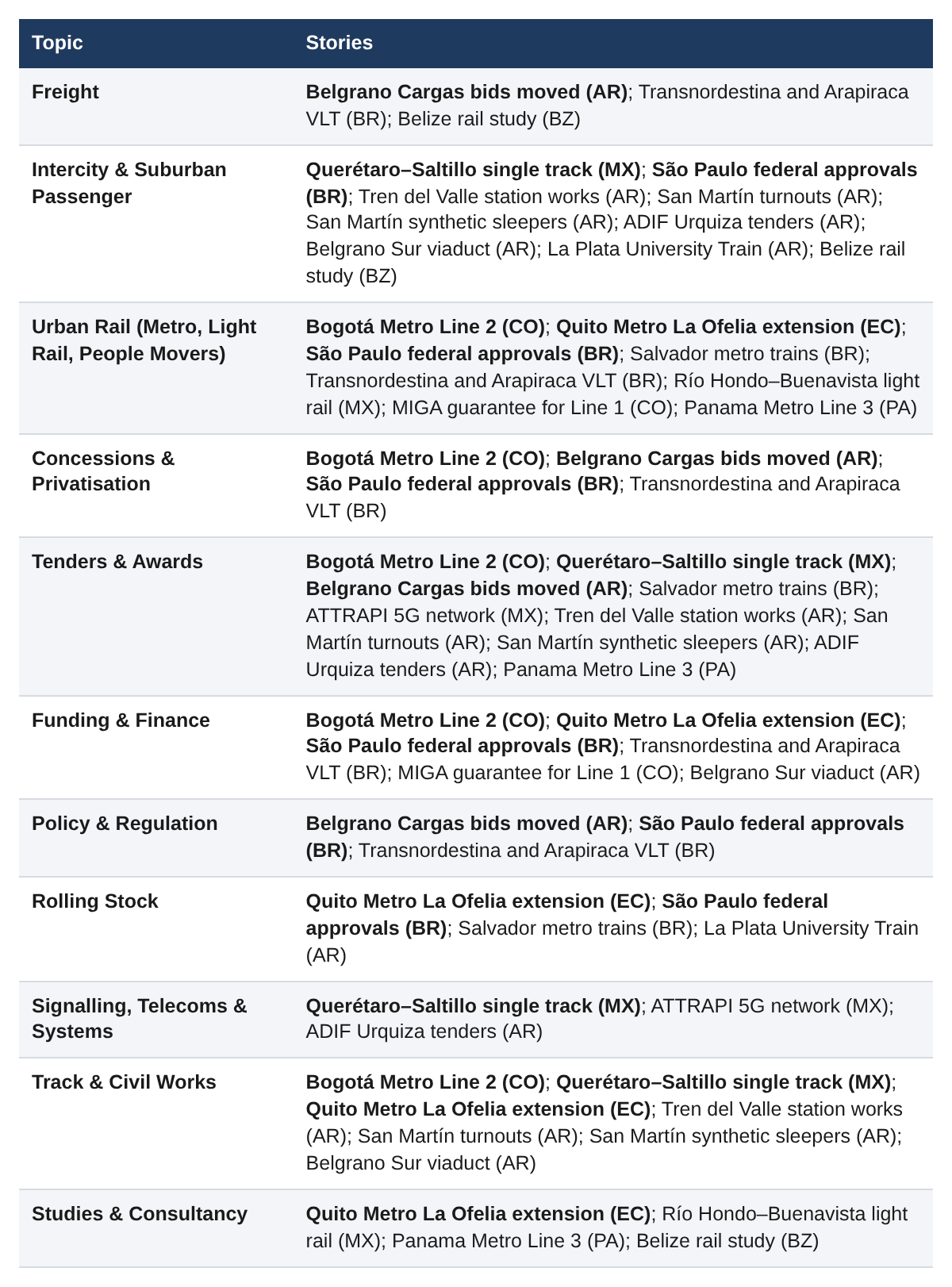
Every story in this issue, listed under each topic it touches. Main items are in bold; the rest appear under Also this week.
Colombia: Three groups prequalified for Bogotá Metro Line 2
On 6 November the Empresa Metro de Bogotá (EMB) published the prequalified list for the Line 2 concession to design, build, finance, operate and maintain the line (Bogotá city hall; Caracol). The three groups are APCA ML2 Bogotá (Mota-Engil Colombia, Mota-Engil Engenharia e Construção África, Mota-Engil México and Spie Batignolles Génie Civil); APCA Metro Capital L2 (Xi’an Metro Colombia and Xi’an Rail Transportation Group); and APCA Bogotá Metro Capital (Sacyr Concesiones Colombia Participadas II and CAF Investment Projects). All three passed an independent technical, legal and financial evaluation, and a review by Control Risks found no conflicts of interest, which had been an issue in the first round. That round was declared void in January 2026 when no group submitted an offer.
Line 2 will run 15.5 km from Calle 72 and Avenida Caracas, where it meets Line 1, to Fontanar del Río in Suba, with ten underground stations and one elevated. Under the timetable the city announced in February, offers are due on 30 November and the contract is to be awarded in January 2027; the date has not been reconfirmed since prequalification (Noticias RCN). The 2023 co-financing agreement between the national government (US$6.13bn, 70%) and the city (US$2.64bn, 30%) totals about US$8.77bn.
What it means. A competitive field has returned after the void first round, with three different models: a European concession developer paired with a train and systems manufacturer, a civil engineering group led by Mota-Engil, and a Chinese metro operator that is already a shareholder in the Line 1 concessionaire. Tunnelling, systems, rolling stock and electromechanical suppliers should expect approaches from all three groups before offers close.
Mexico: Querétaro–Saltillo lot cancelled in favour of single track
The Agency for Trains and Integrated Public Transport (ATTRAPI) notified bidders on 29 October that it had cancelled the tender for the 82 km San Miguel de Allende–Villa de Reyes lot, after bids had been opened on 13 October, citing Article 40 of the Public Works Law (Milenio; Plano Informativo / Reforma). Four consortia, led by ICA, Grupo INDI, OHL, and Calzada Construcciones with China Railway International, had bid between MXN26.87bn and MXN29.0bn (US$1.47bn to US$1.59bn). ATTRAPI says a demand study found that initial traffic does not need the planned double track. The first stage will be single track with passing loops between the San Miguel de Allende refuelling area and an inspection area near San Luis Potosí Industrial, which ATTRAPI describes as an “adjustment” of 126 km of double track, with the second track to follow “as operating and budget conditions evolve”. Deferring it saves about MXN15bn (US$820m) of works and maintenance before 2030 (Potosinoticias).
No date has been set for re-tendering. The 45.5 km Villa de Reyes–San Luis Potosí Industrial tender, suspended in October, has not been reissued; ATTRAPI’s description of the passing loops indicates that the redesign extends over that section. Mota-Engil’s 68 km first section is not reported as affected.
What it means. Last week’s delayed award has become a redesign: the lot will return to market as a smaller package. On a single-track railway, capacity depends on where the passing loops are placed and on the signalling and communications that control them, which raises the importance of the corridor’s systems packages, including the signalling award due this month and the 5G network tender (see Also this week).
Argentina: Belgrano Cargas bids moved to 21 December, with easier entry
Economy Ministry Resolution 1914/2026, signed by Minister Luis Caputo on 3 November and published on 4 November, approves Circular 3 to tender 504/2-0004-LPU26 for the Belgrano, San Martín and Urquiza freight concessions. Queries close on 3 December and bids are due on 21 December, with the first-stage opening the same day, in place of 11 November; some interested parties had asked for up to 90 more days (Perfil; El Economista).
Bidders may now use up to two financial partners to pass the financial tests, and may meet the experience requirement through group companies or a contractor they have signed up. Groups bidding for more than one line need meet only the experience requirement of the most demanding line, although their net worth must still cover every line. Technical partners and nominated contractors share liability for the works and must keep a minimum stake (10%, or 35% if also the financial partner) until 180 days after the works are commissioned. The evaluation committee has also been changed. A report that “key works” had been dropped concerns 11 cancelled Chinese-financed rehabilitation tenders, not the concession’s mandatory works of at least US$800m over five years.
What it means. Last week’s condition has been met: the delay is now formal, and the new rules aim to widen the field after Grupo México’s withdrawal. A financial investor can now pair with an experienced operator or contractor rather than meet every test alone. Contractors named in bids will share liability for the mandatory works, so track, signalling and rolling stock refurbishment suppliers should be talking to likely consortia now.
Ecuador: Quito completes studies for US$663m metro extension
On 28 October Mayor Pabel Muñoz presented the definitive studies by Spain’s Typsa for the 5.4 km extension of Quito Metro Line 1 from El Labrador to La Ofelia, with four stations: Bicentenario, Andalucía, El Rosario and La Ofelia (Primicias; Vistazo). The estimated cost of about US$663m comprises US$522m of civil works (US$96.8m per km, against US$95.7m for the first line), US$13.67m for a dedicated substation and US$127m for eight air-conditioned trains. Construction would take 49 months. CAF has approved an initial US$80m loan, and the city projects construction from 2028 and opening in about 2031 (Expreso). The rest of the financing is not settled, and the city needs national government authorisation to negotiate with multilateral lenders (El Comercio).
What it means. The extension now has a defined scope and cost, including an order for eight trains, but procurement depends on a financing package that is not yet in place. Suppliers already on Line 1 have an obvious interest; the timetable will be set by the multilateral lenders.
Brazil: São Paulo rail projects gain federal financing approvals
Two Ministry of Cities ordinances published in the DOU on 3 November support São Paulo projects. Portaria 1,484 approves Trivia Trens’ modernisation and expansion of CPTM Lines 11-Coral, 12-Safira and 13-Jade, including the Airport Express, as a priority project eligible for incentivised infrastructure debentures of up to R$3.5bn (US$685m) of an estimated R$14.3bn (US$2.8bn) of investment. Works run to 2034 and include extensions on all three lines (Diário do Transporte). Agência iNFRA reported a ministry authorisation for the same project in March, so this may be a formal re-approval. Portaria 1,482 approves the Metro Line 2-Verde extension from Vila Prudente to Penha (8.3 km, eight stations, 22 trains) for REIDI, which suspends PIS/Pasep and Cofins on goods and services bought for the project; opening is expected at the end of 2028 or early 2029 (DOU via Atlas Público; Diário do Transporte).
What it means. Both are eligibility steps, not new contracts. Debenture eligibility lets Trivia Trens finance the Lines 11 to 13 programme with tax-advantaged debt, and REIDI lowers the cost of equipment and services for Line 2-Verde, including its 22 trains. Suppliers to either project should price on the basis of the tax suspension.
Also this week
Argentina
Tren Patagónico has tendered station works for the Tren del Valle extension to General Roca: five stations (Cipolletti, Fernández Oro, Allen, J. J. Gómez and General Roca) and a new access at Cipolletti, at an official budget of ARS1,781m (US$1.16m), over 90 days. Bids open on 24 November in Viedma; services are due to start on 1 December (Noticias NQN).
ADIF has received four bids for 23 broad-gauge turnouts for the San Martín line, in two lots: from Spain, Amurrio Ferrocarril y Equipos and voestalpine Railway Systems JEZ; from China, China Railway Shanhaiguan Bridge Group and China Railway Baoji Bridge Group (enelSubte).
Three Argentine companies, Grupo RFG (Circularis), Induvía and Euromix, have bid in ADIF’s tender for 28,700 recycled-plastic sleepers for the San Martín line, the first broad-gauge use of a programme trialled on the Belgrano in 2023 (Transporte y Energía).
ADIF has moved to 13 November the openings of two Urquiza line equipment tenders: an ATS monitoring system (LP 24/2026) and the Elcano traction rectifier substation (LP 28/2026) (ADIF tender portal).
The City of Buenos Aires has proposed taking over the remaining works on the Belgrano Sur viaduct through Barracas and Parque Patricios, which is about 85% complete and at a standstill; how the line would use Constitución is unresolved (Perfil).
The Universidad Nacional de La Plata has proposed to Trenes Argentinos converting its university train to battery-electric traction, and is separately pursuing an extension to Los Hornos; neither has funding (Economía Sustentable).
Brazil
CTB has adjudicated the contract for ten four-car trains for Salvador Metro Lines 1 and 2 to Consórcio Grupo Alstom at R$632.72m (US$124m) and published the call to sign, after rejecting an appeal by CRRC (A Tarde).
The TCU decision approving the return of 3,014 km of FTL’s Malha Nordeste is Acórdão 2,906/2026, published on 3 November. A separate amendment removes 13.466 km at Arapiraca (Alagoas) from FTL’s lease, freeing the corridor for a light rail scheme; funds for light rail in Arapiraca and Campina Grande will be released once proposals meet technical maturity and governance requirements (Diário do Transporte).
Mexico
ATTRAPI has re-tendered a standalone 5G railway radio network, prepared for ERTMS, covering about 675 km of the Mexico City–Querétaro–Irapuato and Saltillo–Nuevo Laredo sections (LO-09-JZO-009JZO001-T-82-2026). It is a lump-sum contract of 1,321 days, with bids on 9 December and award on 15 December; no value has been published, and a first round was declared void in October (Más Información).
Naucalpan’s mayor, Isaac Montoya Márquez, has put the Río Hondo–Buenavista light rail at MXN15.16bn (US$829m) for 14.6 km, with pre-investment studies under way with European Union participation (Quinta Fuerza).
Colombia
MIGA, the World Bank Group’s guarantee agency, has guaranteed loans to the Bogotá Capital District from BNP Paribas, the first a COP1.3tn loan (about US$400m, as reported) for the city’s share of Metro Line 1, which is about 80% complete (Portafolio; MIGA).
Panama
The Cabinet Council has authorised Metro de Panamá to contract Consorcio PMTS Línea 3, formed by Nippon Koei companies, for US$16.2m of project management and technical assistance on Line 3, particularly the tunnel under the Canal, to June 2029 (La Prensa).
Belize
An IDB-funded study (BL-T1204) of extending the Tren Maya to Belize City and on to Guatemala is due in about two weeks, according to Prime Minister John Briceño (IDB; Breaking Belize News).
Dates to watch
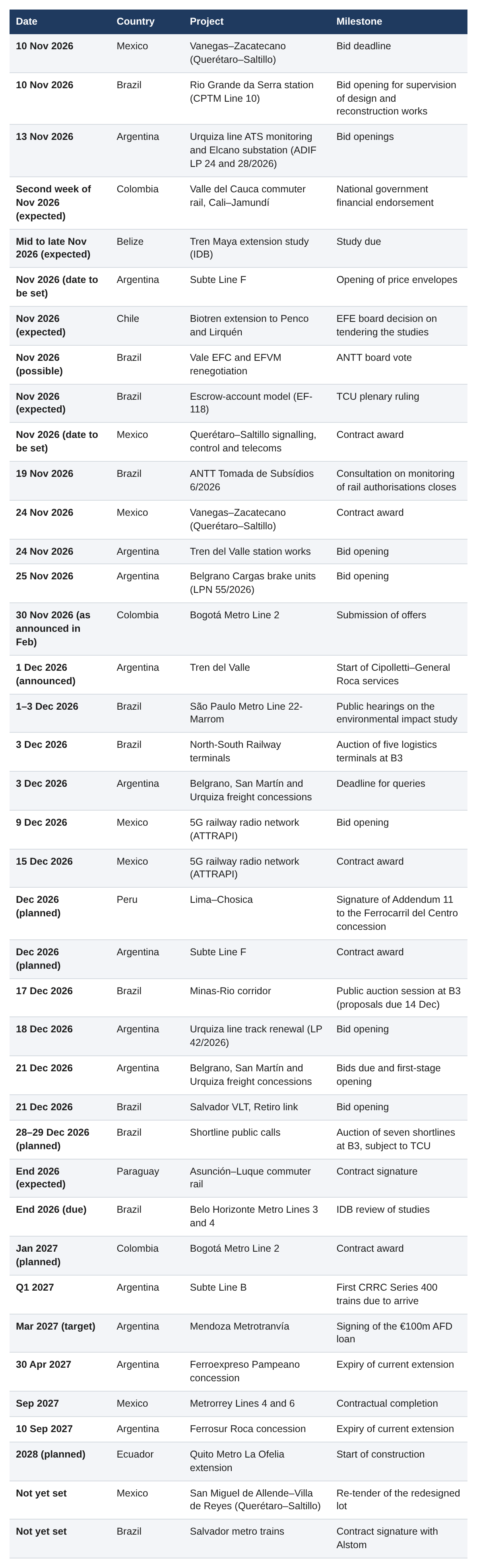
Entries from earlier issues are carried forward until they pass.
About this briefing
Latin American Rail Weekly is published free each week by Latin Rail Intelligence. Organisations that require coverage focused on their own markets, products or competitors can arrange tailored monitoring with us. Enquiries are welcome: andrew.young@latinrailintelligence.com.