

Weekly intelligence on rail projects, tenders, concessions and policy across Latin America, from Latin Rail Intelligence.
Covering news from 28 September to 3 October 2026
Forwarded this issue? Latin American Rail Weekly is free each week: subscribe here
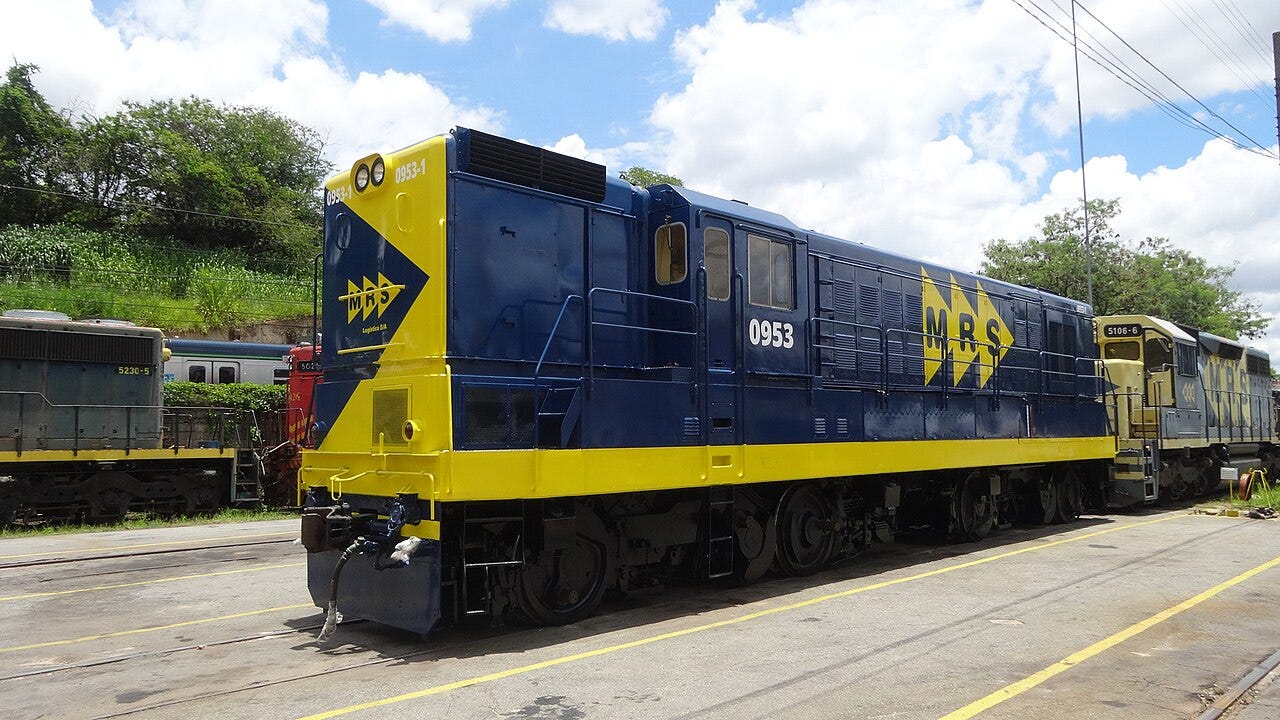
Photo: Rafael Camilo Guimarães Caldeira / Wikimedia Commons (CC BY-SA 4.0)

This week
Brazil set the pace this week: the federal government is preparing its first rail auction in five years and has extended the authorisation model to around 10,000 km of idle track, while Brazilian states advanced urban projects from feasibility studies in Rio de Janeiro to systems design in Salvador and flood recovery in Porto Alegre. In Argentina, the government confirmed that electrification of the San Martín line now depends on the privatisation of Trenes Argentinos Operaciones. CAF approved US$200m for Colombia’s La Dorada–Chiriguaná rail PPP, and the State of Mexico published the scope of its Texcoco–La Paz light rail ahead of tender. Shorter items from across the region follow under Also this week.
Each item gives the facts, then a short assessment of what it means for the supply chain and investors. Brazilian values are converted at approximately R$5.11 per US dollar, the average PTAX rate for September 2026 (numerando); Mexican values at 19.3 pesos per US dollar, the rate used by the Finance Ministry (SHCP) for the 2026 economic package.
Stories by topic
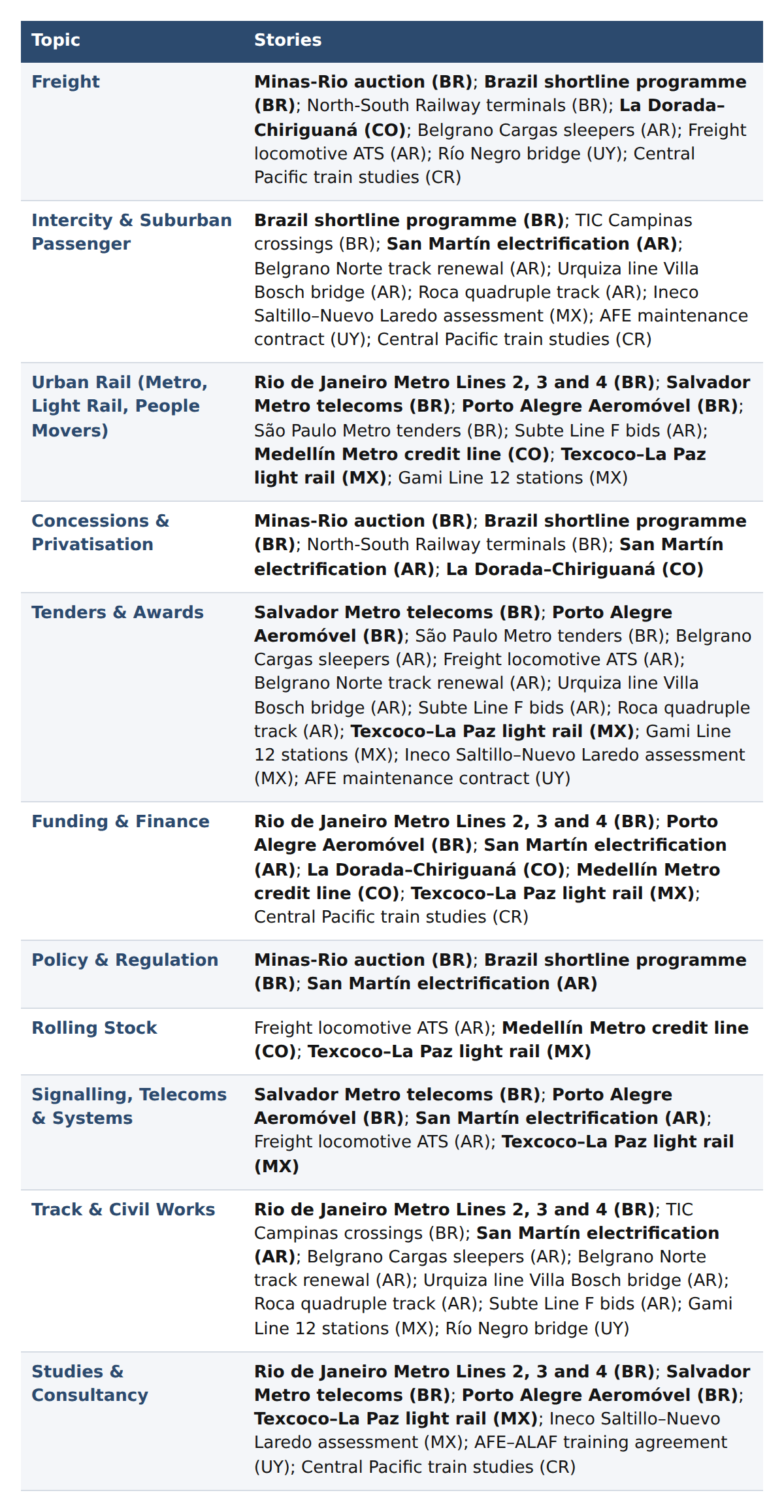
Every story in this issue, listed under each topic it touches. Main items are in bold; the rest appear under Also this week.
Brazil: Minas-Rio auction sets the template for 10,000 km of idle track
The National Land Transport Agency (ANTT) will auction the 733 km Minas-Rio corridor at B3 in São Paulo on 17 December, with proposals due electronically on 14 December (Brasil 247). It will be Brazil’s first rail auction since the FIOL Section I sale in 2021, and the first under the public call (chamamento público) model approved by the Federal Court of Accounts (TCU) on 19 August (Diário do Comércio; Poder360).
The corridor, currently operated by Ferrovia Centro-Atlântica (FCA), is split into two lots: 626 km from Iguatama (MG) to Barra Mansa (RJ), including the Varginha to Lavras branch, and 107 km from Barra Mansa to the port of Angra dos Reis (CNN Brasil). Winners receive 99-year authorisations, the award goes to the highest grant fee from a starting bid of R$1, and each must submit a rehabilitation and modernisation plan within two years of signature (Transporte Moderno). Financial institutions, pension funds and investment funds may bid if they meet the qualification conditions (Brasil 247).
On 15 September the Ministry of Transport presented the wider programme at B3: public calls for around 10,000 km of idle, deactivated or returned lines, starting with seven shortlines (Ministry of Transport). Named sections include Campina Grande to Cabedelo (PB), Brasília to Luziânia (DF/GO) and Santo Ângelo to Santa Rosa (RS) (O Povo). Unlike Minas-Rio, which is awarded on the highest grant fee, shortlines needing public funds will go to the bidder seeking the smallest public contribution (Technibus). Minister George Santoro said the seven shortlines could follow as a second batch, auctioned on 28 and 29 December, subject to the TCU agreeing a shorter interval between publication and auction (Agência iNFRA).
What it means. The R$1 starting bid shows that the value lies in the rehabilitation obligation rather than the grant fee. For suppliers of track, structures, signalling and rolling stock overhaul, the key date is not December but plan approval: with up to two years to submit plans, substantial rehabilitation procurement is unlikely before 2028. The openness to funds is notable, and the points to watch on 17 December are whether FCA bids for its own network and whether any non-operator investor competes. If Minas-Rio attracts credible bidders, the shortline calls that follow could create a new tier of regional freight operators in Brazil.
Brazil: BNDES to structure Rio de Janeiro metro Lines 2, 3 and 4
The Rio de Janeiro state government, the national development bank BNDES and the Coppe engineering institute of the Federal University of Rio de Janeiro (UFRJ) signed a technical cooperation agreement on 25 September to structure three metro projects (TV Prefeito). The scope covers a Line 2 extension from Estácio to Praça XV, Line 4 from Jardim Oceânico to Recreio, and a new Line 3 linking São Gonçalo and Niterói to Rio across Guanabara Bay. Acting governor Ricardo Couto signed for the state.
BNDES will initially fund the studies, which will determine alignments, the starting section and the technology to be adopted, according to Luciene Machado, head of the bank’s Cities Solutions area (Tribuna do Sertão). Line 3 studies are due to conclude by the end of 2027 (Repórter Maceió). Preliminary figures reported for the package are around 44 km, 31 stations and R$28.8bn (US$5.6bn), including R$14.6bn (US$2.9bn) for Line 3 (ABIH-RJ). Couto made clear that starting construction will fall to the next elected governor.
What it means. This is a planning milestone, not a procurement one. The studies will also define the delivery model; if it is a concession or PPP, the first commercial opportunities will be for transaction advisers, engineering consultants and demand modellers during 2027. A Guanabara Bay crossing for Line 3 would be a major tunnelling package, and contractors and TBM suppliers should track the alignment options Coppe is assessing. Timing risk is high: the programme spans a change of state administration.
Brazil: Salvador Metro awards Campo Grande telecoms design contract
The Bahia State Transport Company (CTB) has selected Consórcio Telecom Salvador, formed by MPE Engenharia e Serviços and Ênfase Serviços de Engenharia, to prepare the basic and executive designs for the telecommunications systems on Section IV of Line 1, from Lapa to a new Campo Grande station (BNews). The winning bid was R$41.7m (US$8.2m), and the result was published in the state official gazette on 26 September.
Civil works on the 1.1 km underground extension are held by Consórcio Expresso 2 de Julho (Álya Construtora, OECI, Metrô Engenharia and MPE Engenharia), with a contract of around R$1.1bn (US$217m) and delivery expected in August 2029 (A Tarde). When the works were tendered in 2025, the state set aside a balance of R$356m (US$70m) for telecoms, signalling and control systems and accessibility works (O Consumidor).
What it means. The telecoms design award signals that the systems packages are now moving. Signalling and control, the larger share of the R$356m balance, is the package for international suppliers to watch, and it will need to integrate with the existing Line 1 systems operated by CCR Metrô Bahia. MPE’s presence in both the civil and telecoms consortia makes it a natural local partner for systems bidders.
Brazil: Porto Alegre Aeromóvel reconstruction begins
The Ministry of Cities, the federal urban rail operator Trensurb and the technology supplier Aerom signed the order to start reconstruction of the Porto Alegre Aeromóvel on 23 September (Brasil em Folhas). The 814 m people mover linking Trensurb’s Aeroporto station with Salgado Filho airport has been out of service since floods reached its equipment on 3 May 2024 (Click Petróleo e Gás).
Total investment is estimated at R$40m (US$7.8m) under the federal Novo PAC programme. The first contract, R$9.9m (US$1.9m) with Aerom as sole supplier, covers 12 months of design work for the propulsion, control, communication and electrification systems, plus management of later procurement; the remaining R$30m or so will be tendered (ABC+). Technical rooms and equipment will be raised to reduce flood exposure.
What it means. A small project, but a sign that flood resilience is entering design requirements for Brazilian urban rail after the 2024 Rio Grande do Sul floods. The follow-on packages are modest and the proprietary pneumatic technology limits competition, though civil works and electrical equipment should be open to tender.
Argentina: San Martín electrification now tied to privatisation
The Undersecretariat of Rail Transport has confirmed that the integrated modernisation and electrification of the San Martín line between Retiro and Pilar has been dropped in its original form. In its response to a critical report by the National Audit Office (AGN), it said modernisation objectives compatible with the original project will be assessed within the privatisation of Trenes Argentinos Operaciones (SOFSA) (La Noticia 1).
The Inter-American Development Bank (IDB) approved a US$400m loan for the project in August 2017 (enElSubte). In 2024 the government redirected those funds to a programme supporting public finances and the balance of payments; the response also mentioned the possibility of bringing the infrastructure under the Large Investment Incentive Regime (RIGI) (El Conurbano). In the meantime, Trenes Argentinos Infraestructura (ADIF) is tendering smaller works, including 23 turnouts for the line (enElSubte).
What it means. Electrification risk has passed from the state to the future operator. Bidders for Buenos Aires metropolitan passenger concessions should expect investment obligations, or at least expectations, on the San Martín to feature in the privatisation terms, and should price the diesel-to-electric transition accordingly. For suppliers, near-term opportunities on the line are limited to maintenance-scale tenders; electrification equipment demand will depend on how the concession is structured.
Colombia: CAF lends US$200m to the La Dorada–Chiriguaná rail PPP
The CAF board approved a structured loan of up to US$200m on 1 October to part-finance the La Dorada–Chiriguaná rail corridor, covering rehabilitation and construction, operation and maintenance, and the acquisition of machinery and equipment (Carreteras Pan-Americanas). The PPP is held by Concesión Línea Férrea Central, formed by Ortiz Construcciones y Proyectos, Transporte Ferroportuario de Colombia (Transferport) and CI Colombian Natural Resources I (CNR). It covers 526 km from La Dorada (Caldas) to Chiriguaná (Cesar), with total investment of 3.4 trillion pesos, more than US$1bn.
The loan is one of five Colombian operations totalling US$1.25bn, which also include a credit line of up to US$300m for the Medellín Metro’s investment plan, covering corridor expansion and fleet renewal (El Heraldo).
What it means. Multilateral participation strengthens the financing of a large rail PPP and should make commercial lenders more comfortable with the remaining debt. The loan explicitly covers machinery and equipment as well as rehabilitation, so procurement of track materials, maintenance equipment and rolling stock should follow as works progress; suppliers should approach the concessionaire’s members directly. The Medellín Metro credit line is a separate opportunity for rolling stock and systems suppliers.
Mexico: Texcoco–La Paz light rail scope published ahead of tender
The State of Mexico has published the scope of its 21 km Texcoco–La Paz light rail on the federal Proyectos México platform, ahead of a national public tender (Proyectos México). The contract will cover civil works and systems (track, viaducts, stations, depots, telecommunications, signalling, catenary and power, fare collection), environmental management, utility diversions, right of way and 14 double trainsets. The platform gives no investment estimate, but the state’s 2026 economic package allocates 2.6bn pesos (US$135m) (Chilango).
The line will have 12 stations, connect with Metro Line A at La Paz, and run in mixed operation with freight on existing rights of way of CPKC de México (formerly Kansas City Southern) and Ferrovalle (Poder y Crítica). The state authorities have set a target of 2027 for the start of operation.
What it means. A broad single package of civil works, systems and rolling stock, but tendered nationally: foreign systems and rolling stock suppliers will need a Mexican partner. Shared operation with freight on CPKC and Ferrovalle track will require access and safety agreements with both, which is a timing risk for the 2027 target.
Also this week
Brazil
Five logistics terminals on the North-South Railway at Palmeirante and Porto Nacional (TO) go to auction at B3 on 3 December (Ministry of Transport; CNN Brasil).
São Paulo Metro opened tenders for fire-detection equipment and torsion springs, after five equipment and parts tenders earlier in the week; CPTM is buying design software and tendering cables (Diário do Transporte).
The São Paulo intercity train (TIC) obtained authorisations for two rail crossings in Campinas, part of a R$14.2bn (US$2.8bn) project (Diário do Transporte).
Argentina
Trenes Argentinos Cargas has tendered sleepers for the General San Martín freight line (LPN 52/2026) and security services (LPN 48/2026) (Trenes Argentinos Cargas).
UTE Ferromel–Herso–Emepa and Benito Roggio Ferroindustrial are competing to install ATS equipment on 140 freight locomotives (enElSubte).
Contracts have been awarded for track renewal on the Belgrano Norte line (Qué Pasa Web), and the Villa Bosch bridge repair on the Urquiza line is close to award (enElSubte).
Two consortia bid for Buenos Aires Subte Line F, one led by CITIC Construction with Panedile and one formed by Roggio and Ghella (enElSubte); bids were also opened for the three stages of the Roca line’s quadruple-track renewal between Constitución and Temperley (El Diario Sur).
Mexico
ATTRAPI, which took over completion of the Line 12 extension from the city government this year, has awarded Gami and a partner construction of two stations worth US$125m, including Valentín Campa (BNamericas).
Spain’s Ineco will carry out the safety assessment of the Saltillo–Nuevo Laredo passenger corridor (Vía Libre).
Uruguay
AFE will contract a company to manage maintenance for its passenger services, and has signed a framework agreement with ALAF for staff training (Crónica Ferroviaria).
Recovery work has begun on the railway bridge over the Río Negro, restoring the link between Rivera and the port of Montevideo (Presidencia).
Costa Rica
CABEI has approved technical cooperation for pre-investment studies for the Central Pacific train to Puntarenas and Caldera, covering passenger and freight services (Teletica). The studies had stalled for lack of funding (El Observador).
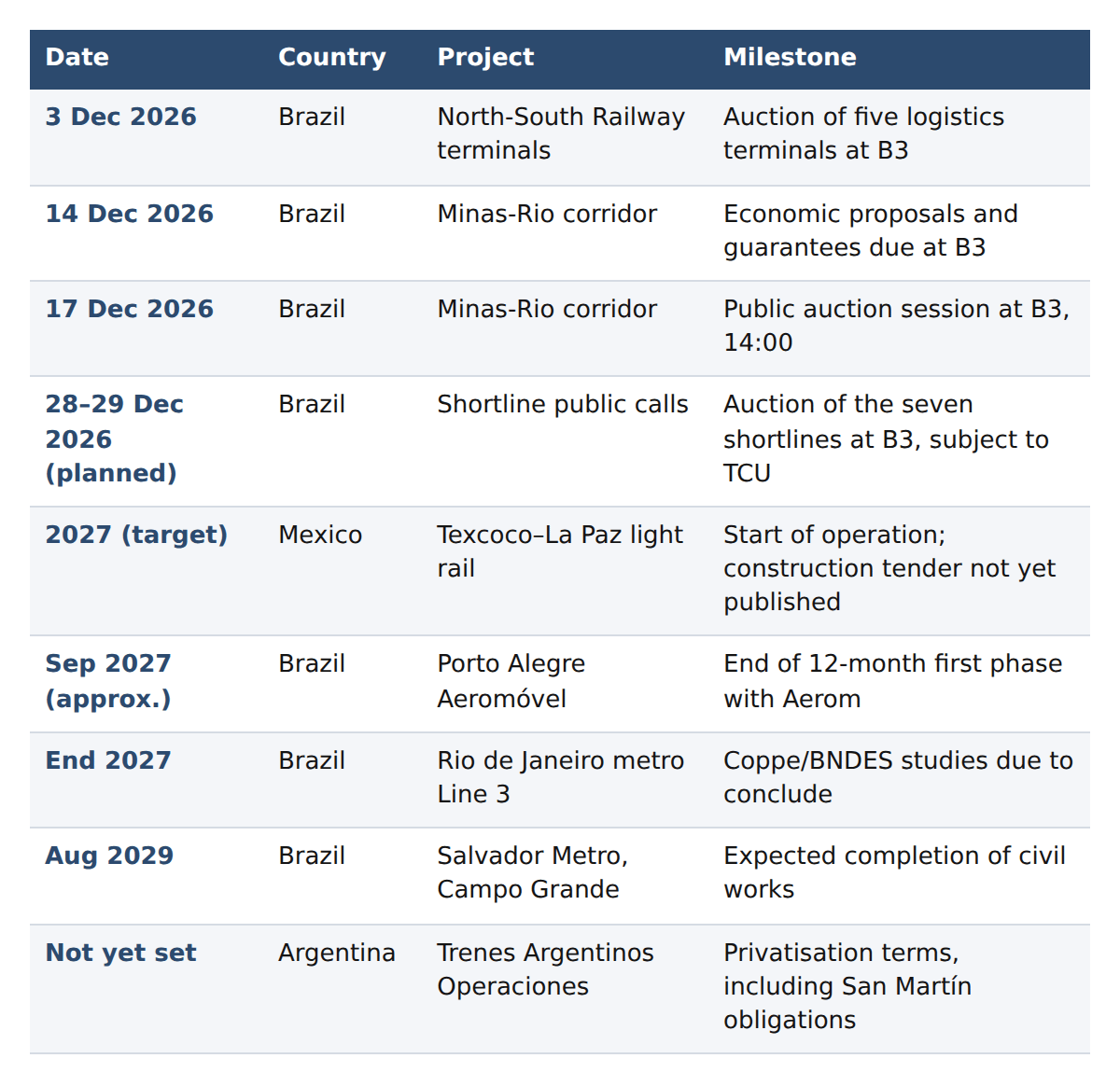
Dates to watch
About this briefing
Latin American Rail Weekly is published free each week by Latin Rail Intelligence. If a colleague forwarded this issue to you, you can subscribe at weekly.latinrailintelligence.com/subscribe .
Organisations that require coverage focused on their own markets, products or competitors can arrange tailored monitoring with us. Enquiries are welcome: andrew.young@latinrailintelligence.com.
Sources
Minas-Rio and authorisation model: Ministry of Transport; Brasil 247; CNN Brasil; Diário do Comércio; Poder360; Transporte Moderno (auction); Transporte Moderno (10,000 km); O Povo; Technibus; Agência iNFRA; BNamericas
Rio de Janeiro metro: TV Prefeito; Tribuna do Sertão; Diário do Rio; Repórter Maceió; ABIH-RJ
Salvador Metro: BNews; A Tarde; O Consumidor
Porto Alegre Aeromóvel: Brasil em Folhas; ABC+; Click Petróleo e Gás
San Martín line: La Noticia 1; enElSubte (electrification); enElSubte (turnouts); El Conurbano
La Dorada–Chiriguaná: CAF; Carreteras Pan-Americanas; El Heraldo; BNamericas
Texcoco–La Paz: Proyectos México; Chilango; Poder y Crítica
Also this week: sources linked in each item
Exchange rates: numerando, USD/BRL PTAX 2026; SHCP 2026 economic package rate as quoted on Proyectos México