

Covering news from 19 to 24 October 2026
Weekly intelligence on rail projects, tenders, concessions and policy across Latin America, from Latin Rail Intelligence.
Forwarded this issue? Latin American Rail Weekly is free each week: subscribe here.
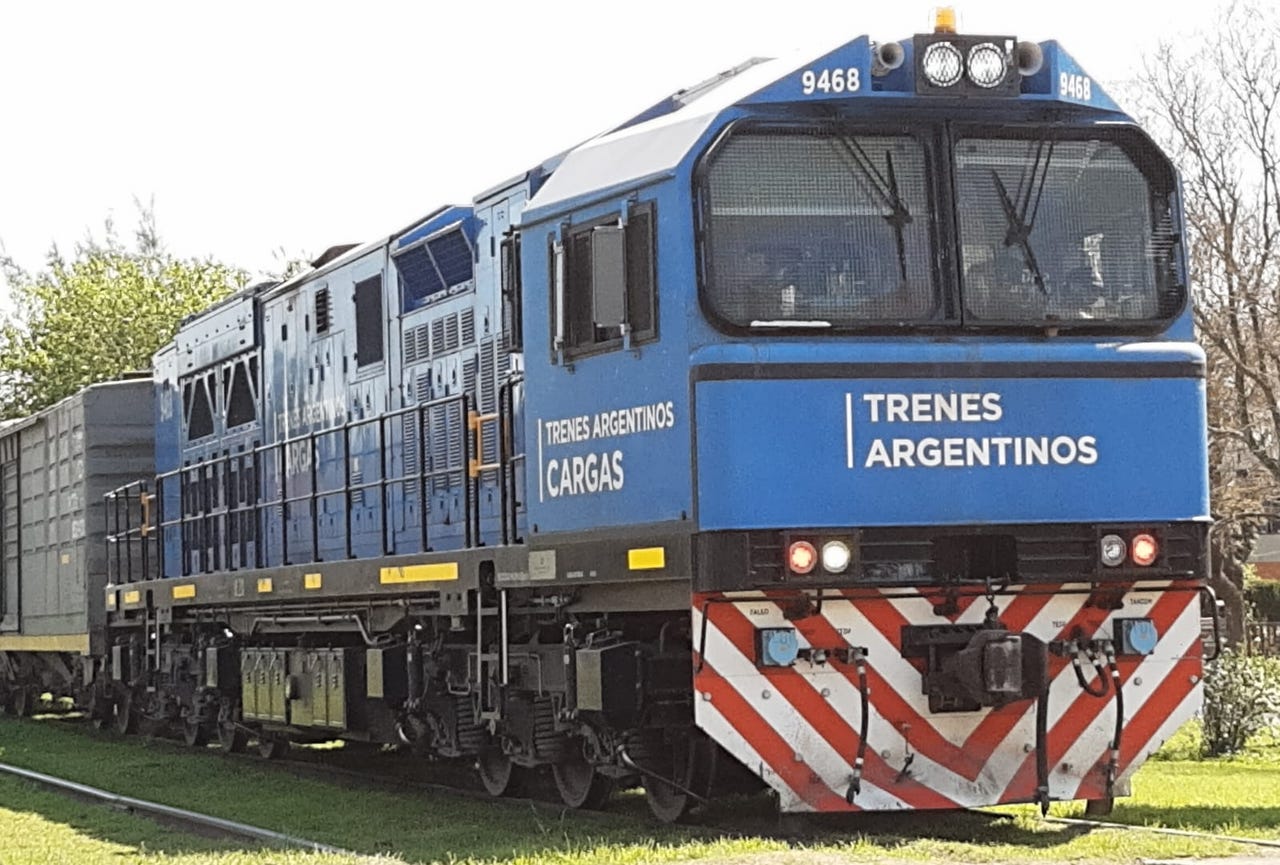
Photo: PUTAMBORIL / Wikimedia Commons (CC BY-SA 4.0)
This week
Grupo México’s withdrawal from Argentina’s Belgrano Cargas tender, three weeks before bids open, led the week. The same week also brought a foreign arbitration seat, letters of interest from the private-sector arms of the IDB and the World Bank, and the cancellation of the Chinese-financed Belgrano works programme. In Brazil, the federal rail concession programme presented at B3 now has every freight auction scheduled for 2027. In Chile, Australian contractor Martinus won track and electrification on Santiago Metro Line 9. In Mexico, bids of up to US$1.57bn arrived for the next Querétaro–Saltillo lot, with the award due on 27 October. Shorter items from Brazil, Mexico, Argentina, Chile, Bolivia and Guatemala follow under Also this week.
Each item gives the facts, then a short assessment of what it means for the supply chain and investors. Exchange rates are unchanged from last week: Brazilian values at approximately R$5.11 per US dollar, the average PTAX rate for September 2026 (numerando); Mexican values at 18.28 pesos per US dollar, the Banxico FIX rate on 2 October 2026 (Líder Empresarial); Argentine values at 1,542 pesos per US dollar, the wholesale rate on 8 October 2026 (El Cronista).
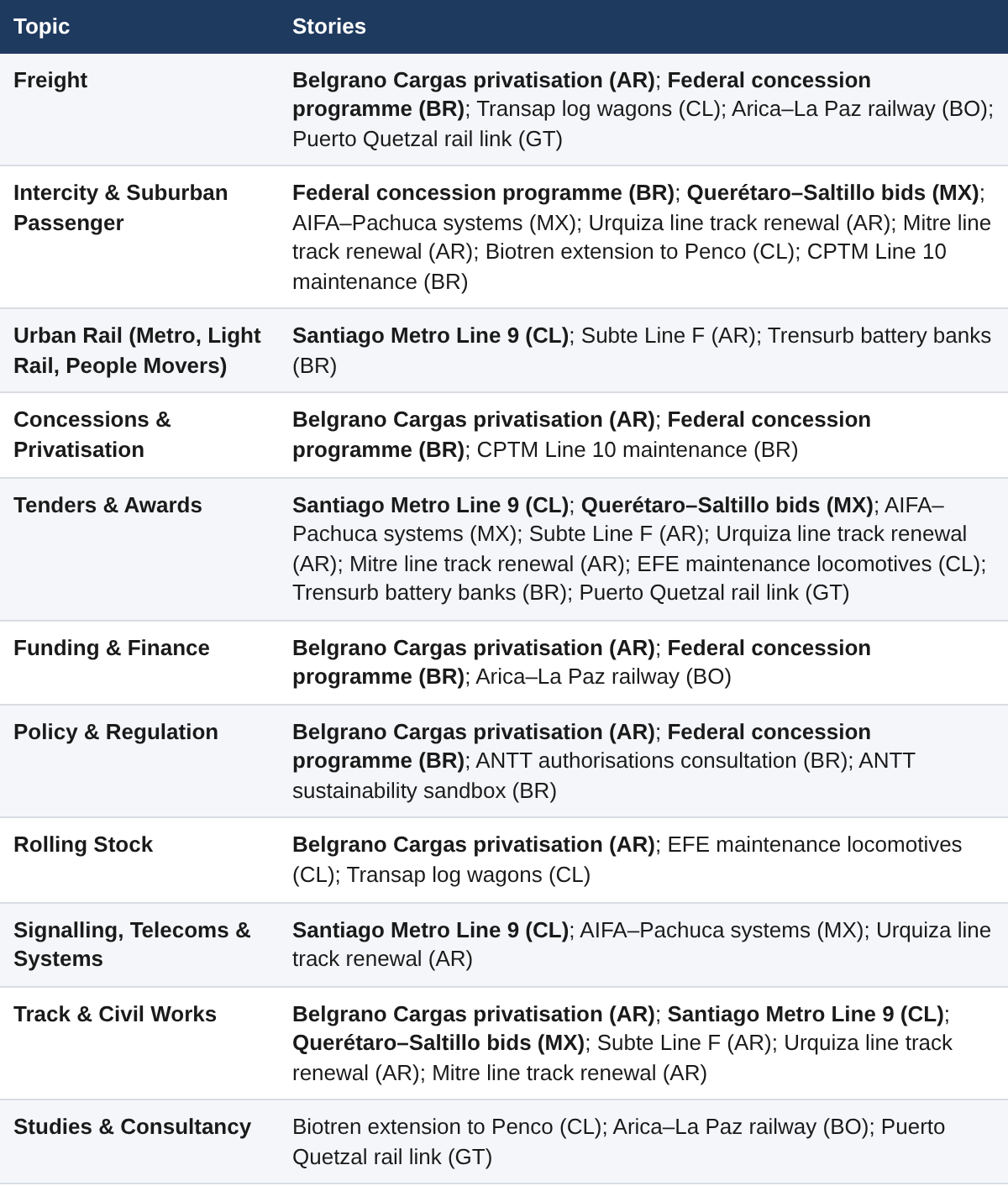
Stories by topic
Every story in this issue, listed under each topic it touches. Main items are in bold; the rest appear under Also this week.
Argentina: Grupo México quits the Belgrano Cargas tender three weeks before bids
Grupo México Transportes (GMXT), which operates Ferromex and Ferrosur in Mexico, has withdrawn from the tender for 50-year concessions on the Belgrano, San Martín and Urquiza freight networks (7,594 km), confirming the decision to Reuters on 21 October (GBM, from Reuters). In a press release the following day, Grupo México said its board had decided not to proceed because the terms did not reflect the vertically integrated model it had recommended. It described open access as a model that “is inefficient, reduces the competitiveness of the system as a whole, increases costs and prices for customers and requires public subsidies to sustain it” (enelSubte). GMXT had partnered US locomotive builder Wabtec, which has made no public comment.
GMXT was the only international group to have shown interest. The known contender is the Consorcio Pro Ferrocarril Belgrano of agro-exporters Bunge, Cargill, Louis Dreyfus, ACA and AGD. Infobae also names Grupo Roggio and mining companies including First Quantum, Rio Tinto, Glencore and Vicuña as interested, and Perfil reports that Techint is looking at the San Martín. Officials are discussing postponing the 11 November bid opening and amending the terms (Infobae; Perfil).
The same week brought three other moves. Decree 1216/2026, published on 19 October, allows concession disputes to be arbitrated in Montevideo, Uruguay (Crónica Ferroviaria). BID Invest and IFC, the private-sector arms of the Inter-American Development Bank and the World Bank Group, have written to the government expressing interest in financing bidders without sovereign guarantee, for works and for buying the state rolling stock sold with the concessions; neither letter is a financing offer (enelSubte). And the government has rescinded all 11 works contracts financed under its 2013 agreement with China Machinery Engineering Corporation (CMEC); only the Santa Fe bypass, about 70% complete, carries into the concession as a mandatory work (enelSubte).
The tender documents set out the public support. A trust will contribute about US$498m to mandatory works: US$386m on the San Martín, US$78m on the Belgrano and US$34m on the Urquiza. The San Martín’s rolling stock, including 36 CRRC-built locomotives and 1,766 wagons, is priced at US$131.7m, and its access charge is set between US$0.0071 and US$0.0203 per tonne-km (San Martín tender conditions, PLIEG-2026-79596056-APN-ST#MEC). Last week we gave the Belgrano trust as up to US$78.5m; the tender documents put it at US$78.0m.
What it means. The tender has lost its only bidder with large-scale international freight operating experience and a locomotive manufacturer as partner. The field now rests on shipper-led consortia and mining interest, and the government must choose between delaying to rework the open-access model and proceeding with fewer bidders. For suppliers, about US$500m of trust money for mandatory track renewal is committed whoever wins, and the BID Invest and IFC letters make financing more accessible to local bidders. Whether the new owners renew or refurbish the state fleet, including its CRRC-built locomotives, will shape rolling stock demand.
Brazil: Federal rail concession programme moves to 2027
Transport Minister George Santoro presented the federal rail concession portfolio at B3, the São Paulo stock exchange, on 15 October. The eight freight auctions first presented for 2026 are now scheduled for 2027, leaving the Minas-Rio authorisation call as the only rail project offered in 2026. Review by the federal audit court (TCU) of the ministry’s escrow-account model is expected to resume in November; the Southeast Ring (EF-118) tender depends on it, with an auction in April if the notice is published in December. Financeability remains open: BNDES plans a 40-year credit line, guarantee talks are under way, and Santoro said cheaper foreign capital is needed (Agência iNFRA). The package, reported at R$160bn (US$31.3bn), comprises four greenfield corridors (Southeast Ring, 575 km; East-West, Ilhéus to Lucas do Rio Verde, 2,400 km; Ferrogrão, 933 km; and the North-South extension from Açailândia to Belém, 553 km), four re-awards (Malha Oeste, Paraná–Santa Catarina, Rio Grande and Mercosul), five idle lines under the authorisation model, three passenger reinstatements (São Luís to Itapecuru Mirim, Fortaleza to Sobral, Brasília to Luziânia) and 12 North-South terminals, plus state projects including São Paulo to Sorocaba, CPTM Line 10 with Line 14, and the Recife metro (Railway Gazette). The ministry plans an investor roadshow in London after the presidential run-off on 25 October.
What it means. Every federal freight auction now falls after the new administration takes office in January, so timetables and models may be revisited. That makes the Minas-Rio authorisation auction on 17 December, the only federal rail sale left on the 2026 calendar, the test of investor appetite. For contractors and suppliers, the greenfield corridors remain the largest source of civil works and track demand, but construction now follows 2027 awards and TCU clearance.
Chile: Martinus wins Santiago Metro Line 9 track and electrification
Martinus, the Australian rail contractor working in Chile since 2021 on maintenance and project delivery for the state railway company, Empresa de los Ferrocarriles del Estado (EFE), has won the design-and-build contract for track and overhead electrification on Santiago Metro Line 9, a project of the state-owned metro operator Metro de Santiago, plus a separate 20-year maintenance contract. The 27 km line has 19 stations and six interchanges and is a US$2.7bn project. The contract value was not disclosed. Martinus says the work will create 300 jobs, taking its Chilean workforce to 600 (Railway Gazette).
What it means. The award brings another international specialist into Santiago’s metro supply chain, and the 20-year maintenance contract gives Martinus a long-term base in Chile beyond EFE. Suppliers of rail, fastenings, track systems and overhead line equipment should look to Martinus for Line 9 procurement.
Mexico: Bids of up to US$1.57bn for the next Querétaro–Saltillo lot
The Agency for Trains and Integrated Public Transport (ATTRAPI) has received bids of up to US$1.57bn for the 82 km San Miguel de Allende–Villa de Reyes lot of the Querétaro–Saltillo passenger line, from consortia led by OHLA, ICA, Azvi and China Railway. The award is due on 27 October, 11 days later than planned (BNamericas). El CEO, citing ATTRAPI documents reported by Milenio, lists a further lot from Villa de Reyes to the San Luis Potosí industrial zone (45.5 km) and reports 14 companies interested in Charcas–Vanegas and more than 30 across the lots (El CEO). The first lot, Querétaro–San Miguel de Allende (68 km), went to a Mota-Engil consortium for 22.4bn pesos (US$1.23bn) this month.
What it means. The top bid works out at about US$19m per km, against about US$18m per km on the first lot. The bidder list mixes Spanish, Mexican and Chinese contractors, so Chinese state groups are now competing for civil works on the corridor. With more than 30 companies interested across the lots, subcontractors and materials suppliers have several consortia to approach before the November deadlines.
Also this week
Brazil
Brazil’s National Land Transport Agency (ANTT) has opened a call for evidence (Tomada de Subsídios 6/2026) on how it monitors construction of privately authorised railways. Holders currently report under a 2023 ordinance (Portaria Sufer 6/2023): every six months before works start and every four months once they are under way. ANTT proposes to require more detail on works schedules and investment commitments, and to set binding deadlines for its own review. Contributions are open until 19 November (Diário do Transporte).
ANTT has provisionally selected MRS Logística, Rumo Malha Paulista and Rumo Malha Central for level II of its sustainability programme for regulated federal railways, a regulatory sandbox (Diário do Transporte).
Trensurb, the federal company that runs the Porto Alegre metropolitan rail line, has awarded both lots of a tender for battery banks to Saft do Brasil for R$2.33m (US$0.46m) (Diário do Transporte).
CPTM, the São Paulo state suburban rail operator, has postponed its Line 10 permanent way maintenance tender for the fourth time, to 27 October; Line 10 is due to be concessioned, with tendering in 2027 (Diário do Transporte).
Mexico
China Railway Signal & Communication (CRSC) says its international subsidiary has won the general EPC contract for the low-voltage systems (communications, signalling and SCADA) of the 57 km AIFA–Pachuca line, due to open in 2027; no value or client was published (MexCham).
Argentina
Two consortia are competing for Buenos Aires Subte Line F (estimated at US$1.35bn; 9.8 km, 12 stations, driverless GoA4 operation): Roggio with Ghella, and CITIC Construction and Ranken Railway Construction with Supercemento, Eleprint and Panedile. Price envelopes are due in November and award is planned for December (Transporte y Energía).
Trenes Argentinos Infraestructura (ADIF) has called tender LP 42/2026 for design-and-build renewal of both tracks in six sectors of the electrified Urquiza passenger line, including bridges, level crossings, turnouts, signalling and ATS interfaces and power works, over 450 days; bids open on 18 December (Crónica Ferroviaria; ADIF notice).
ADIF has opened the price envelope for renewal of 1,996 m of track on the Mitre line’s José León Suárez branch, part of the World Bank-funded Mitre modernisation; the sole bidder, Pose, remains in contention (enelSubte).
Chile
Chile’s state railway company, EFE, has awarded CRRC Dalian-Temoinsa a contract to supply four diesel locomotives for infrastructure maintenance, replacing units more than 60 years old, with first delivery in about 18 months (Jornal Portuário). Separately, Transap has landed 30 new Chinese-built log wagons at Valparaíso for forestry traffic for Arauco and CMPC (PortalPortuario).
EFE Sur, EFE’s southern subsidiary, says the extension of Biotren, the suburban rail service it runs in the Concepción area, to Penco and Lirquén will move to feasibility, engineering and environmental studies, worth about US$16m over three years, with the board due to approve tendering in November; works could start in 2032 and services in 2034, at an estimated US$210m (CPI).
Bolivia
After Chilean President José Antonio Kast’s visit to La Paz on 16 October, Bolivia says it is working on reactivating the Arica–La Paz railway, with Bolivian trains running through to the Chilean port, and that a rail roadmap prepared with CAF will be presented shortly (Emol).
Guatemala
The Guatemalan government’s award, made in June, of US$10m to the US government for the US Army Corps of Engineers to design a rail link and multimodal station between Puerto Quetzal and Escuintla has reached the procurement record; President Bernardo Arévalo says the studies are under way, and Prensa Libre reported in July that design is planned for the second half of 2026 and construction contracts for 2027 (Infobae; Prensa Libre).
Dates to watch
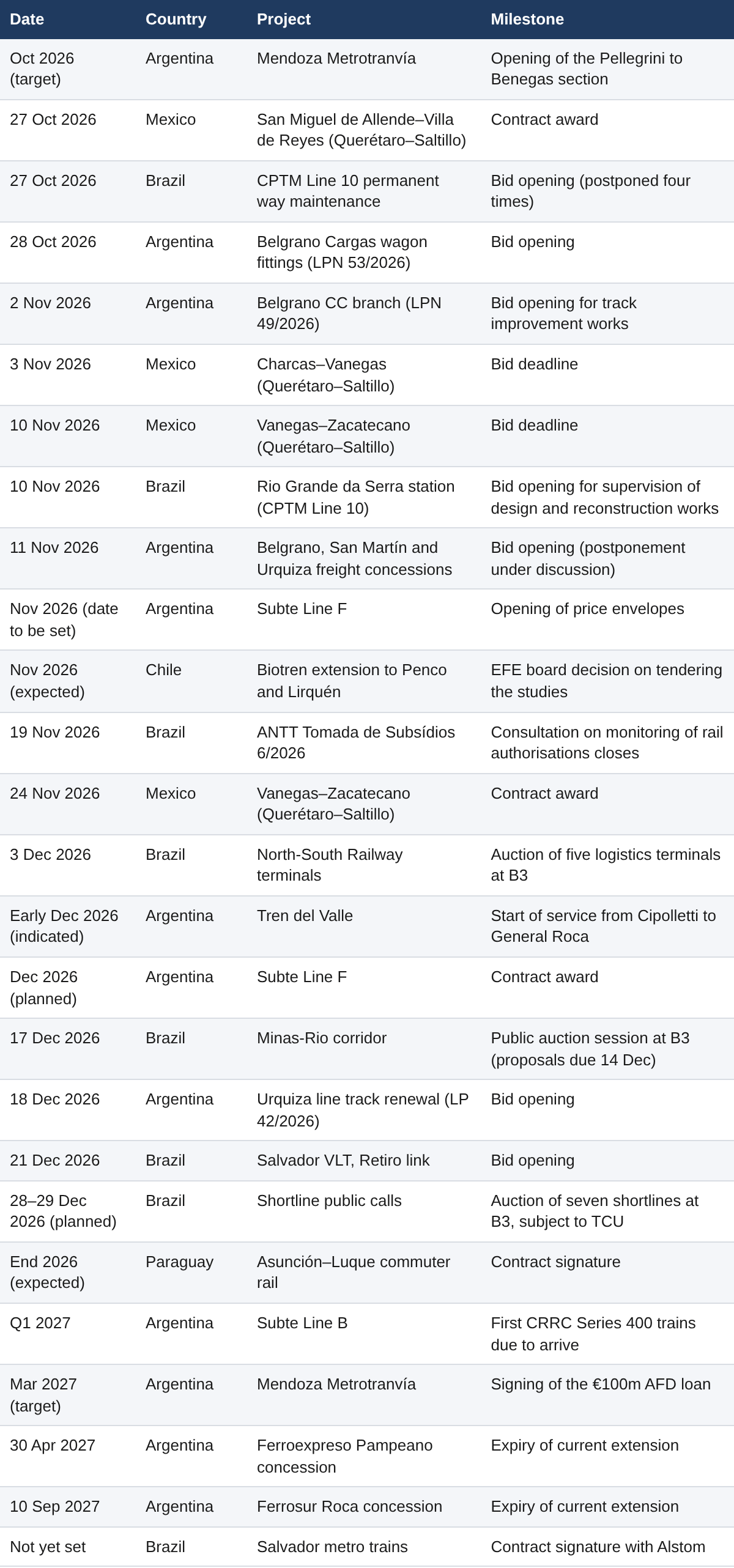
Entries from earlier issues are carried forward until they pass.
About this briefing
Latin American Rail Weekly is published free each week by Latin Rail Intelligence. Organisations that require coverage focused on their own markets, products or competitors can arrange tailored monitoring with us. Enquiries are welcome: andrew.young@latinrailintelligence.com.
Sources
Belgrano Cargas: GBM (Reuters); enelSubte (Grupo México statement); Grupo México press release 001/26, 22 October 2026 (X, @GMexico_Prensa); Infobae; Perfil; El CEO; Crónica Ferroviaria (Decree 1216/2026); enelSubte (BID Invest and IFC); enelSubte (CMEC works); San Martín tender conditions, PLIEG-2026-79596056-APN-ST#MEC
Brazil federal programme: Railway Gazette; Agência iNFRA
Santiago Line 9: Railway Gazette
Querétaro–Saltillo: BNamericas; El CEO
Also this week: sources linked in each item
Exchange rates: numerando, USD/BRL PTAX 2026; Líder Empresarial, Banxico FIX 2 October 2026; El Cronista, wholesale rate 8 October 2026