

Weekly intelligence on rail projects, tenders, concessions and policy across Latin America, from Latin Rail Intelligence.
Covering news from 16 to 21 November 2026
Forwarded this issue? Latin American Rail Weekly is free each week: subscribe here
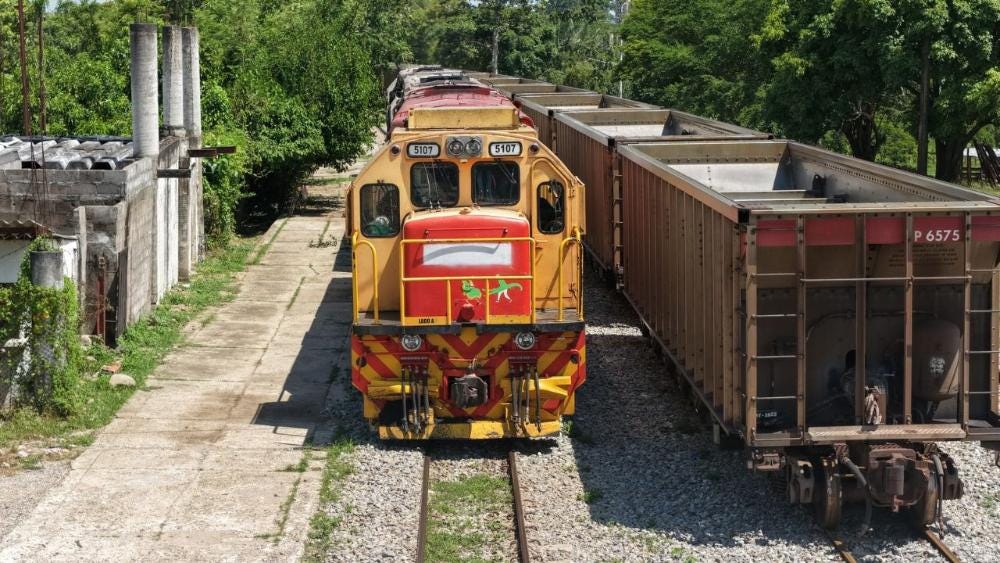
Photo: ANI
This week
In Colombia, the La Dorada to Chiriguaná freight corridor, the country’s first railway PPP, has reached financial close. In Mexico, the US Export-Import Bank is lending US$99m for the modernisation of 30 Ferromex locomotives, while CRRC and Alstom have shown their hand in the 52-train tender. Peru has tendered the pre-investment study for the 355 km Barranca to Trujillo railway, and the CAF Group has won its first rail contract in the country. In Argentina, ADIF has awarded Mitre line resignalling and completed the Belgrano Norte renewal package. Shorter items from Bolivia, Brazil, Chile, Colombia, Mexico and Uruguay follow under Also this week.
Each item gives the facts, then a short assessment of what it means for the supply chain and investors. Exchange rates: Colombian values at 3,309.55 pesos per US dollar, the TRM for 18 November 2026 certified by the Superintendencia Financiera (RTVC); Brazilian values at approximately R$5.11 per US dollar, the average PTAX rate for September 2026 (numerando); Mexican values at 18.28 pesos per US dollar, the Banxico FIX rate on 2 October 2026 (Líder Empresarial); Peruvian and Uruguayan values in US dollars as reported by the sources.
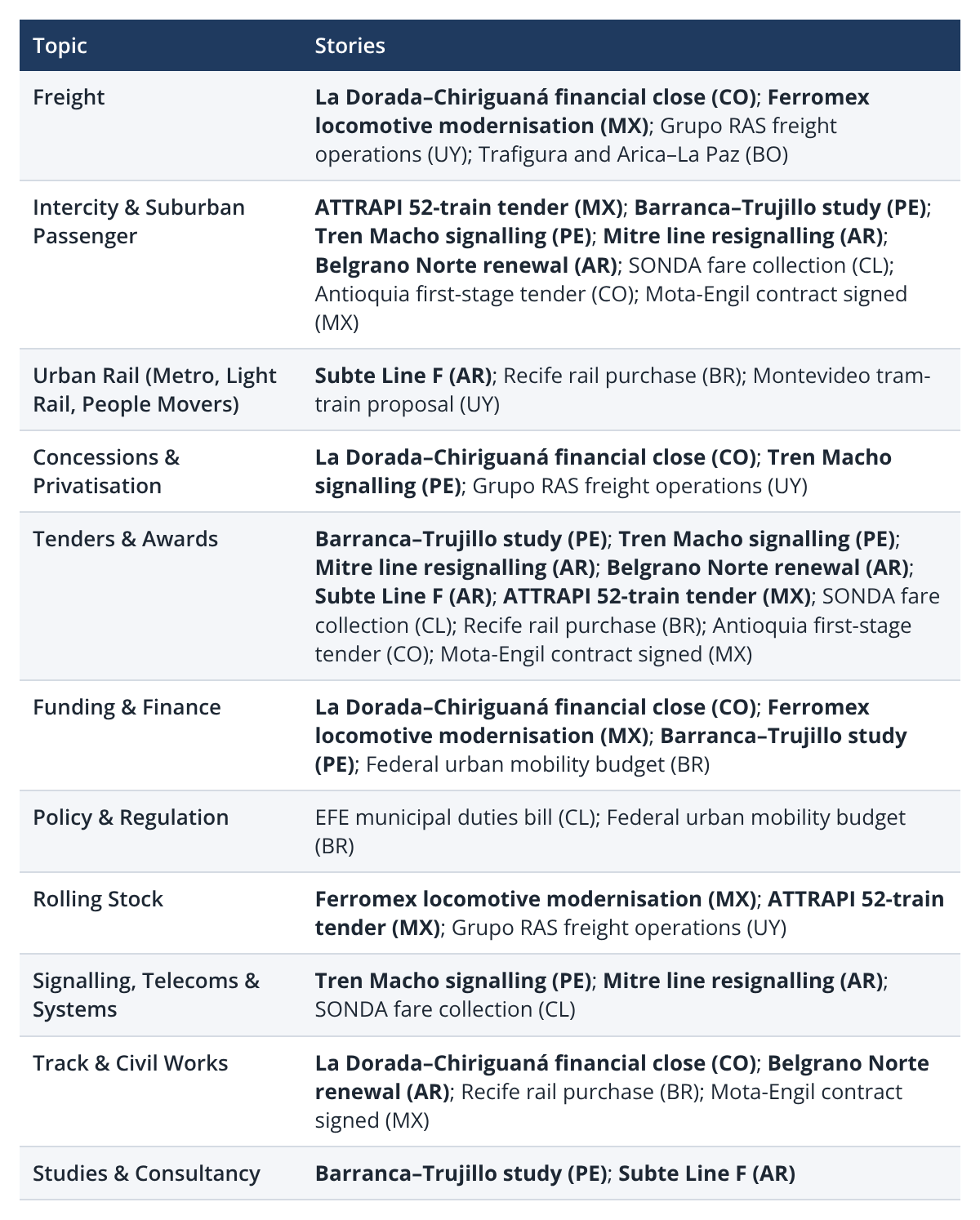
Stories by topic
Every story in this issue, listed under each topic it touches. Main items are in bold; the rest appear under Also this week.
Colombia: La Dorada–Chiriguaná freight PPP reaches financial close
Concesión Línea Férrea Central, the concessionaire for the 526 km La Dorada–Chiriguaná corridor, has reached financial close for COP2.01tn (US$607m). The lenders are Bancolombia, Davivienda, Itaú, the state-owned Financiera de Desarrollo Nacional (FDN, up to COP248.36bn, US$75m) and CAF (up to COP569bn, US$172m); the commercial banks’ shares have not been disclosed (Forbes Colombia; Valora Analitik). The National Infrastructure Agency (ANI) awarded the ten-year concession, sponsored by Grupo Ortiz and Transferport, in April 2025, with an estimated investment of COP3.4tn (US$1.03bn). The works include rehabilitation of track and bridges, 1,480 hydraulic structures, replacement of 205.5 km of 75 lb/yd rail with 115 lb/yd, new signalling and train control, a central control centre, two maintenance workshops and a cargo transfer centre at La Dorada (ANI). The line mainly carries cement, steel, raw materials for ceramics and paper, coffee, cocoa, fertilisers and food products (BNamericas).
What it means. Funding for the main works is now in place, so procurement by the concessionaire should follow: rail, sleepers, signalling and train control, workshop equipment and civil works are all in scope. The lending group, a mix of domestic banks, FDN and CAF, is a useful test case for the next rail concessions in Colombia’s pipeline.
Mexico: US EXIM lends US$99m for Ferromex locomotive modernisation
The Export-Import Bank of the United States (EXIM) has approved a US$99m loan to Grupo Ferroviario Mexicano, the holding company for Ferromex, to finance the modernisation of 30 EMD locomotives by Progress Rail, a Caterpillar company. Some reports described it as a purchase; EXIM’s release makes clear that the units are existing locomotives being modernised. The loan was made under EXIM’s China and Transformational Exports Program (EXIM). It follows nearly US$185m approved by EXIM in September 2025 for Grupo México Transportes’ fleet renewal with modernised Wabtec locomotives (EXIM). Ferromex holds the Pacific-North trunk concession of more than 6,500 km (El CEO).
Separately, the 52-train passenger tender drew 610 questions at its first clarification meeting: 540 from the CRRC subsidiary México Railway Transportation Equipments and 70 from Alstom Ferroviaria México; CAF México is registered but asked none (El Economista via Yahoo). ATTRAPI’s notice confirms the trains are diesel multiple units equipped with ERTMS, with bids due on 18 December, award on 8 January and contract signature on 21 January 2027 (ATTRAPI notice).
What it means. Grupo México’s freight business is renewing its fleet through modernisation as well as new-build purchases, and US export credit is being used explicitly to compete with Chinese financing. On the passenger side, CRRC and Alstom are shaping up as the main contenders for the 52 trains, with the volume of questions pointing to further clarification rounds and a possible slip in the award date.
Peru: MTC tenders Barranca–Trujillo railway study
The Ministry of Transport and Communications (MTC) has called a public tender for the profile-level pre-investment study of a 355 km mixed passenger and freight railway between Barranca and Trujillo, through Lima, Áncash and La Libertad. The study will estimate demand, compare route options and assess viability. Offers are due on 16 December, with award planned for 17 December. Up to US$4m comes from the Multilateral Cooperation Center for Development Finance (MCDF), channelled through CAF, the Development Bank of Latin America and the Caribbean, under an agreement signed in March that put the study’s total cost at US$10.8m (MTC; El Peruano). The ministry’s rail portfolio puts the cost of the line at around US$5bn (MundoMarítimo).
What it means. For consultancies, this is an early entry point to a line the ministry values at around US$5bn: demand forecasts, route options and the viability case will be set at this stage. Multilateral grant funding covers part of the cost, and CAF’s role as implementing partner brings a development bank into the project from the outset.
Peru: CAF Group wins first Peruvian rail contract, Tren Macho signalling
The CAF Group, a multinational provider of integrated rail transport systems, has won its first rail contract in Peru. Its signalling division will supply signalling, train protection, telecoms and traffic control, including ETCS Level 1 trackside and on-board equipment and a centralised traffic control centre, on the 128.7 km Huancayo–Huancavelica railway (Tren Macho). The contract was awarded by the concessionaire, Cofeperú; its value has not been disclosed (CAF; IRJ).
What it means. The award shows Peru’s rail concessions turning into equipment orders, with ETCS now specified on a regional line in the central Andes. As with this award, further packages on the line, such as track, civil works and rolling stock, are likely to be let by the concessionaire rather than the state, so suppliers should approach Cofeperú directly.
Argentina: ADIF awards Mitre resignalling and completes Belgrano Norte package
Trenes Argentinos Infraestructura (ADIF) has awarded two signalling contracts on the Mitre line’s José León Suárez branch. Benito Roggio e Hijos will unify the signalling between Pueyrredón and José León Suárez, with fibre-optic communications, a local traffic control centre, automatic block and ATS, cutting the minimum headway from 16 to 3 minutes over two and a half years, financed by CAF. UTE Ferromel–Herso will modernise signalling and telecoms from José León Suárez to Zárate, with a radio link, ATS and absolute block (enelSubte). ADIF has also awarded the last two of six Belgrano Norte packages: renewal of 17 km of double track with UIC 54 rail on concrete sleepers to UTE Herso–Ferromel–C&E Construcciones, and 23 turnouts to Voestalpine Railway Systems JEZ (enelSubte). No values have been published. In Buenos Aires, both Subte Line F bids (CITIC Construction-led and Roggio–Ghella) have been found admissible; prices are opened after 20 November, with a constructability workshop on 30 November and award still planned for December (enelSubte).
What it means. Apart from the turnout supply, which went to Voestalpine, every contract in these state-funded packages has gone to Argentine firms, with Herso and Ferromel winning on both lines. For signalling and telecoms suppliers, subcontract and equipment opportunities now sit with these winners. Line F moves to its price stage with two bidders left.
Also this week
Bolivia
Trafigura is assessing a reactivated Arica–La Paz railway as a route for Bolivian foreign trade, including mineral concentrates, its Latin America director Edmundo Vidal told La Razón. The decision depends on capacity, cost and reliability; its subsidiary Impala Terminals already operates a concentrate terminal at Arica, and Mejillones via Ollagüe is also being considered (Reporte Minero).
Brazil
The 2027 budget proposal cuts the federal urban mobility programme from R$3.04bn to R$1.96bn, but the cut falls on road works: the line for public transport systems rises 71.8% to R$1.19bn (US$233m). The Ministry of Cities has also set aside R$541m (US$106m) for the transfer of the Recife metro to Pernambuco state, linked to a concession (Diário do Transporte).
CBTU has opened a tender for 741.82 tonnes of TR-57 rail for its Recife system, with bids opening on 4 December (Diário do Transporte).
Chile
EFE has awarded SONDA a US$8m, 30-month contract for access control and fare collection on the Alameda–Melipilla and Santiago–Batuco lines: 117 gates and 155 self-service machines at 16 stations (Portal Innova).
The Senate Transport Committee has unanimously approved a bill exempting EFE from municipal duties on railway works, already passed by the Chamber of Deputies. EFE cited those charges when it deferred the underground Lo Errázuriz–Alameda section of the Melipilla line in September (Cámara de Diputados; Meganoticias).
Colombia
Antioquia plans to tender the first stage of its railway, Bello–Barbosa (29.8 km, six stops), in early 2027, as public works or a PPP, Governor Andrés Julián Rendón told investors in Miami (El Colombiano).
Mexico
Mota-Engil México has signed its MXN22.4bn (US$1.23bn), 32-month contract with ATTRAPI for the 68 km Querétaro–San Miguel de Allende section, awarded in October, including a tunnel, 20 viaducts and four bridges (RTP).
Uruguay
Grupo RAS has started freight operations on the Ferrocarril Central between the Port of Montevideo, its Progreso industrial park and Rivera, with seven Wabtec locomotives and an investment of about US$102m (Presidencia).
Stadler has told the Senate Transport Committee that its Montevideo tram-train would cost about US$300m less than the government’s BRT over 30 years; a government agency report reaches the opposite conclusion (Crónica Ferroviaria, from la diaria).
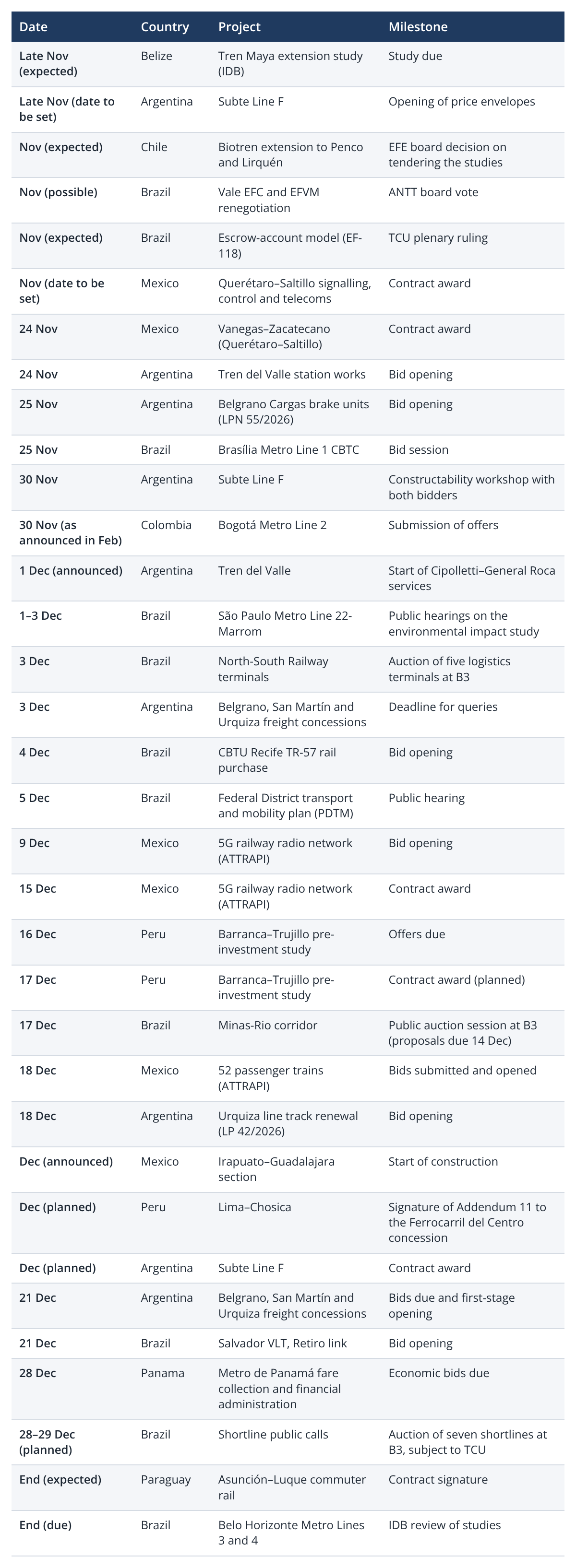
Dates to watch
Remaining in 2026
2027 and later
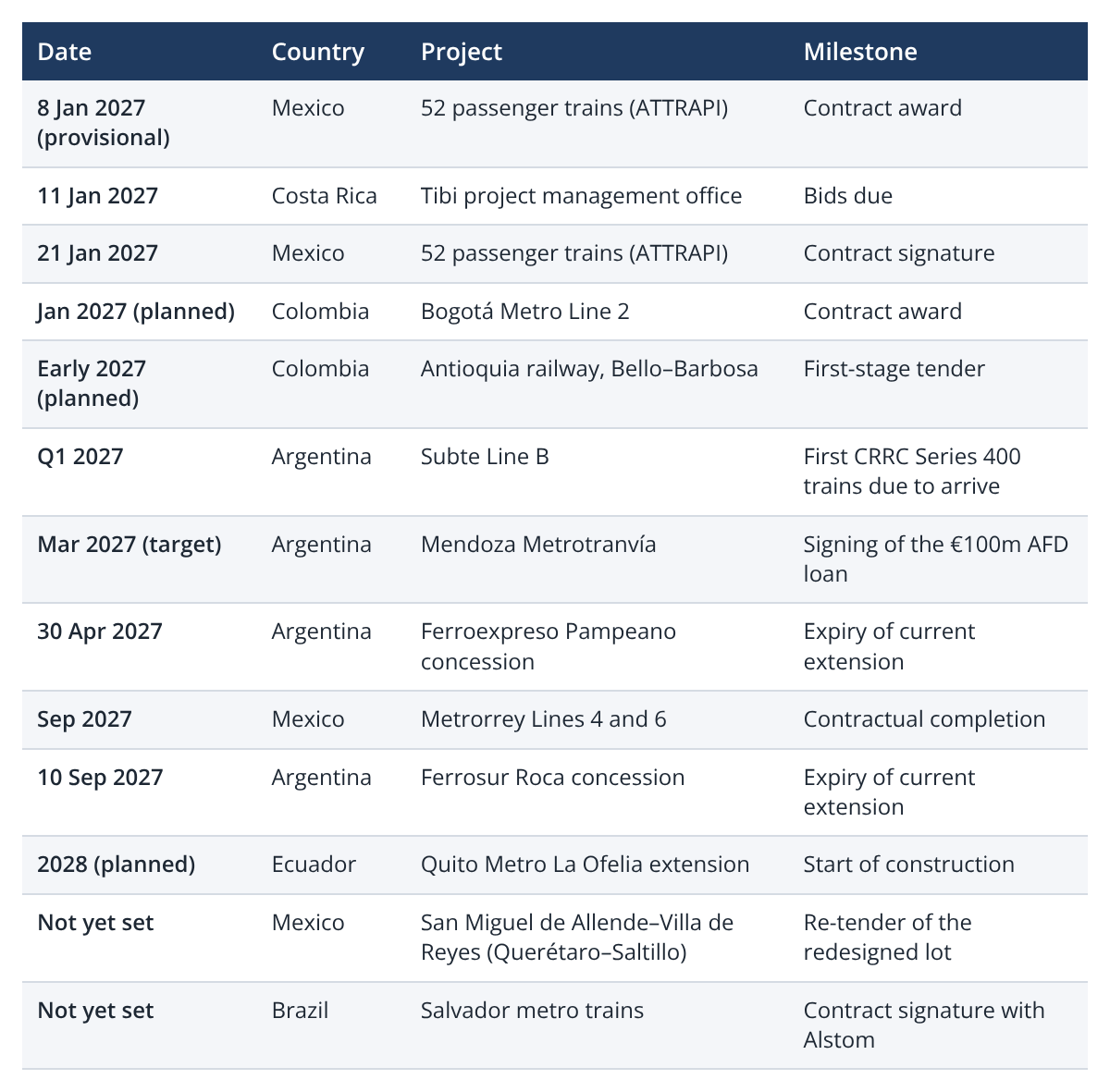
Entries from earlier issues are carried forward until they pass.
About this briefing
Latin American Rail Weekly is published free each week by Latin Rail Intelligence. Organisations that require coverage focused on their own markets, products or competitors can arrange tailored monitoring with us. Enquiries are welcome: andrew.young@latinrailintelligence.com.