

Weekly intelligence on rail projects, tenders, concessions and policy across Latin America, from Latin Rail Intelligence.
Covering news from 26 to 31 October 2026
Forwarded this issue? Latin American Rail Weekly is free each week: subscribe here.
Source: ATTRAPI
This week
In Mexico, the award of the next Querétaro–Saltillo lot has slipped again, to 20 November, the bid opening for a third lot has been suspended, and the corridor-wide signalling and telecoms award is due in November. In Argentina, a week after Grupo México’s withdrawal, the government is weighing a delay to the Belgrano Cargas tender to attract more bidders, and plans to sell the rolling stock and concession the workshops separately. In Brazil, the federal audit court has cleared the return of 3,014 km of idle Transnordestina track, while the Vale renegotiation and the escrow-account ruling both head for decisions in November. Guatemala’s Congress has passed a special law for the Metroriel, and Colombia’s new government will fund studies for Bogotá Metro Line 4. Shorter items from Argentina, Brazil, Mexico, Colombia, Peru, Uruguay and Venezuela follow under Also this week.
Each item gives the facts, then a short assessment of what it means for the supply chain and investors. Exchange rates: Brazilian values at approximately R$5.11 per US dollar, the average PTAX rate for September 2026 (numerando); Mexican values at 18.28 pesos per US dollar, the Banxico FIX rate on 2 October 2026 (Líder Empresarial); Argentine values at 1,542 pesos per US dollar, the wholesale rate on 8 October 2026 (El Cronista); Colombian values at 3,148.02 pesos per US dollar, the official TRM on 28 October 2026 (Diario del Sur).
Stories by topic
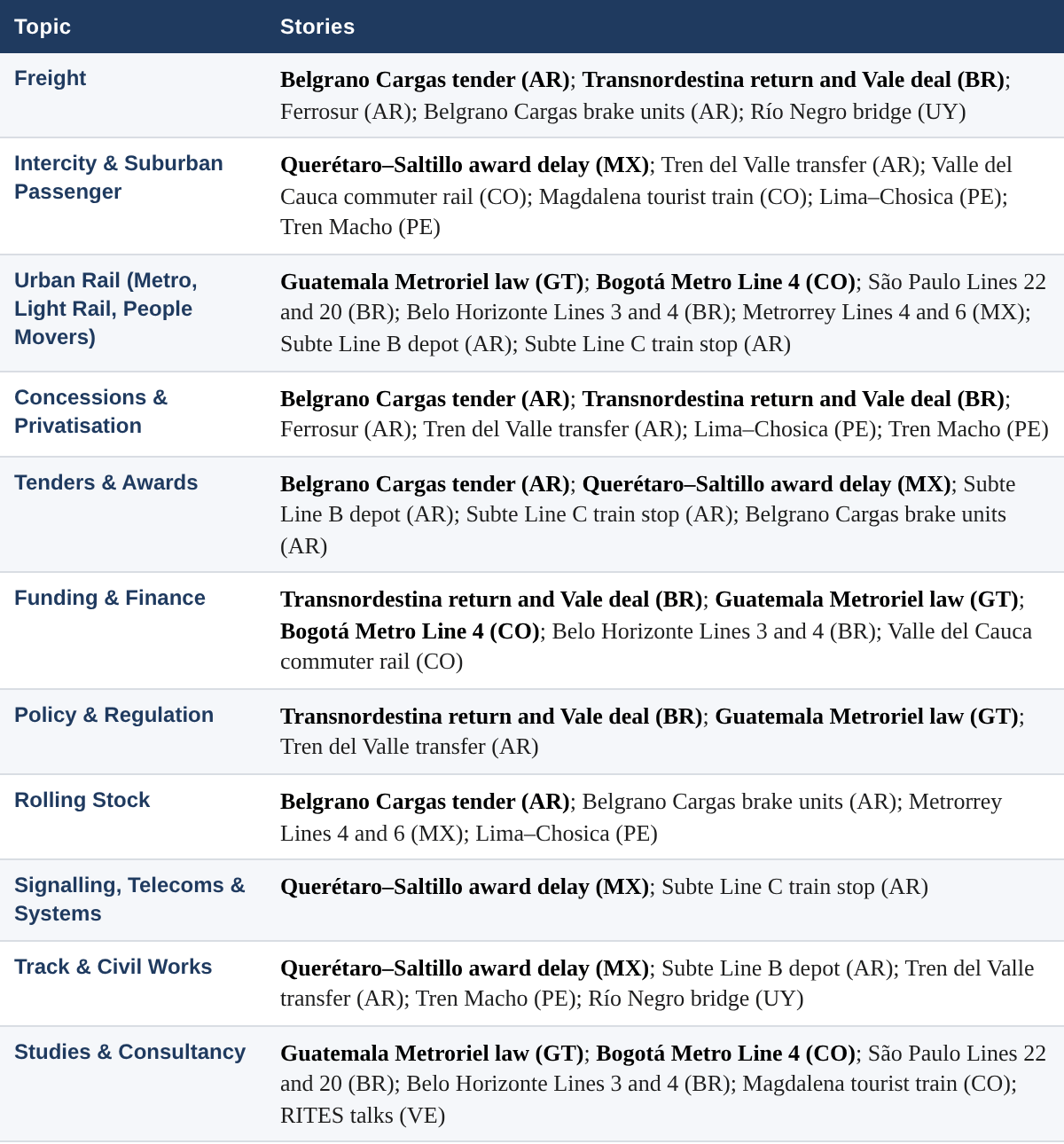
Every story in this issue, listed under each topic it touches. Main items are in bold; the rest appear under Also this week.
Mexico: Querétaro–Saltillo award slips to 20 November and one lot is suspended
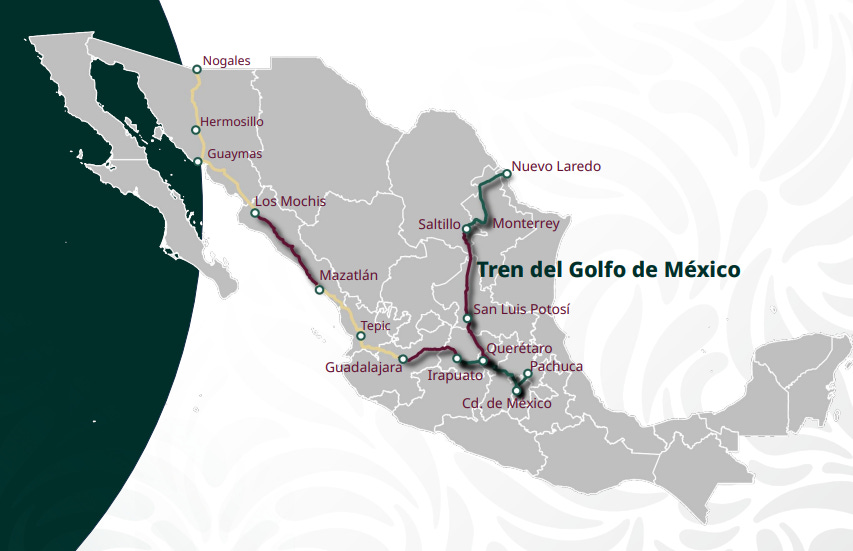
The Agency for Trains and Integrated Public Transport (ATTRAPI) has moved the award of the 82 km San Miguel de Allende–Villa de Reyes lot again, to 20 November; it was due on 27 October, and originally on 16 October. It has also suspended until further notice the bid opening for the 45.5 km Villa de Reyes–San Luis Potosí Industrial lot, scheduled for 26 October, citing modifications to the project (Milenio; Pulso). Bids for the 82 km lot reach US$1.6bn, and the signalling, control and telecoms tender for the full 571.5 km Querétaro–Saltillo corridor is also due for award in November (BNamericas). Pulso puts the delay to the start of construction on the lot at 35 days.
What it means. The schedule for the civil works is slipping lot by lot, and ATTRAPI has not said what has changed on the San Luis Potosí section. The corridor-wide signalling, control and telecoms award is the largest systems package on the line, and suppliers of signalling, communications and control equipment should watch for it in November.
Argentina: Government weighs Belgrano Cargas delay as it seeks more bidders
The government is considering postponing the 11 November opening of bids for the 50-year Belgrano, San Martín and Urquiza freight concessions, but as at 29 October no new date had been published (Infobae; Agencia Nova). Infobae reports that the request for more time came from a private bidder. Construar reports that the aim is to add bidders to the eight parties that have already shown interest, naming four of them: a consortium of grain exporters, Grupo Roggio, Techint and Grupo Emepa. It also reports that the government is preparing a second tender for the sale of the rolling stock and the concession of the workshops, separate from the network concessions (Construar).
Separately, on 21 October the Municipality of Tafí Viejo (Tucumán) filed an amparo in the federal courts against Economy Ministry Resolution 1761/2026, which assigned parts of the town’s 23 ha heavy wagon workshop to Belgrano Cargas y Logística ahead of the workshops concession. The municipality disputes title and has asked that the province be joined as owner (Ámbito; El Monterizo).
What it means. Until a circular is issued, 11 November remains the formal date, and bidders must plan for both outcomes. The eight expressions of interest come from a single report and are not bids. Selling the rolling stock and workshops in a separate tender would create a distinct opportunity for fleet buyers, lessors and maintenance contractors, independent of who wins the networks. The Tafí Viejo case shows that title to some workshop assets may be contested.
Brazil: TCU clears Transnordestina track return as Vale deal reaches ANTT
Ferrovia Transnordestina Logística (FTL), controlled by the steelmaker CSN, holds the concession for the Malha Nordeste, the former federal network across Brazil’s North East privatised in the 1990s. ANTT lists the network at 4,295 km, but only about 1,233 km is in operation, and much of the rest has been idle for years. A sister company, Transnordestina Logística (TLSA), is building the separate new Transnordestina line (ANTT concessions list; ANTF Agenda Institucional 2026). The federal audit court (TCU) has now approved, with changes, an agreement between the National Land Transport Agency (ANTT) and FTL under which FTL returns 3,014 km of idle Malha Nordeste track to the federal government and pays an indemnity of R$1.785bn (US$349m). The TCU announced the decision on 28 October and recommended signature as “more advantageous than a long legal dispute” (CNN Brasil; Folha de S. Paulo). Payment and FTL’s main obligations depend on the extension of its concession, expected in 2028. FTL must decommission the returned infrastructure, regularise environmental and land matters and invest R$136.28m (US$26.7m) in works to reduce conflicts with urban areas; the TCU added that the indemnity and converted fines may not pay for maintenance FTL already owes, and required a detailed works and spending schedule (O Liberal / Estadão).
The Vale renegotiation of the 2020 renewals of the Carajás (EFC) and Vitória–Minas (EFVM) concessions has reached ANTT, whose board could vote in November. The deal would bring the government a further R$7bn (US$1.37bn), and the ministry wants to use it to close viability gaps on other rail projects, possibly including the Fico–Fiol corridor. The TCU’s ruling on the ministry’s escrow-account model is also expected in November; if approved, the Southeast Ring (EF-118) would be the first rail auction (Agência iNFRA). The ministry began a London investor roadshow on 30 October for its 2027 portfolio of 18 rail auctions, with R$160bn (US$31.3bn) of rail investment (Agência iNFRA).
What it means. Brazil is using renegotiated concession contracts both to settle old liabilities and to raise money for new lines. November is decisive: an ANTT vote on Vale and a TCU ruling on escrow accounts would clear the way for EF-118 and give the 2027 pipeline a working funding mechanism. For suppliers, the FTL agreement adds a defined programme of urban-conflict works in the North East, but the main obligations wait for the 2028 extension.
Guatemala: Congress passes the Metroriel law
The Metroriel is a proposed 21 km electrified light rail line with 20 stops, linking the Centra Sur transport hub in Villa Nueva with Centra Norte in Guatemala City, largely along the segregated corridor of the former national railway. Studied since 2016 and planned for years as a public-private partnership, the project moved in July 2026 to a government-to-government partnership with the United Kingdom (IRJ). On 27 October Congress approved, by 134 votes and as a matter of national urgency, Decree 24-2026, the Law for the Implementation of the Railway System, a special legal framework for the Guatemala City Metroriel (AGN; Emisoras Unidas). The law makes Ferrocarriles de Guatemala (Fegua) responsible for every stage from planning to commissioning. It allows the direct contracting of an international specialist firm or consortium to run a Project Technical Management Office, which may not then bid or subcontract on the project. Works, equipment and related services are taken outside the State Procurement Law and are to be procured to international standards, with NEC contracts mentioned and international arbitration permitted; pre-investment, design and engineering may run in parallel. Contracts must be published on Guatecompras, and Fegua must report to Congress every six months. The government says the law enables the partnership with the United Kingdom signed on 9 July (Diario de Centro América); UK Export Finance support for Guatemala’s mobility plans has been reported at more than US$6bn (Revista E&N). The law awaits presidential sanction and publication.
What it means. The law replaces national procurement rules with an internationally styled framework built for government-to-government delivery. The first contract will be the technical management office, a direct appointment that will shape the specifications for everything that follows; programme managers and engineering consultants should watch for it once the law is in force.
Colombia: Government to fund Bogotá Metro Line 4 studies
After meeting Mayor Carlos Fernando Galán, President Abelardo de la Espriella said he had ordered that the studies and designs for Bogotá Metro Line 4 be financed through the national infrastructure fund FONDES and that the project be included in the National Development Plan. Line 4 would run north from Calle 100. The government also backs the northern extension of Line 1 towards Avenida 68 and Calle 100, which the city plans to begin contracting next year (El Espectador; Semana). The President said the 2027 national budget includes COP1.9tn (US$604m) for Line 1 and denied any cut (RTVC; Valora Analitik). Representative María del Mar Pizarro says the government wants to cut the COP1.235tn (US$392m) appropriated for the metro by up to 44.9% as part of a reprogramming of transport funds; the President describes it as adjusting payments to the works schedule (El Espectador).
What it means. The new national government is continuing support for Bogotá’s metro rather than reopening it. For Line 4 the commitment covers studies only, so the near-term opportunity is for engineering and transport consultants; the Line 1 northern extension is the nearer prospect for contractors.
Also this week
Argentina
Economy Ministry Resolution 1853/2026 formally transfers the Tren del Valle to Río Negro province, which may operate passenger services through Tren Patagónico for ten years, without exclusivity, on corridors from Villa Regina to Neuquén, Plottier and Zapala; Governor Alberto Weretilneck says Cipolletti–General Roca services start on 1 December, with four trains each way a day and five new stops (Literal; Noticias NQN).
Loma Negra chief executive Sergio Faifman said the company will bid when the Ferrosur Roca concession, extended year by year without a formal tender, is re-tendered (CD Noticias).
In the Line B Taller Rancagua depot tender (SBASE LPI 264/2026, civil works and an underfloor wheel lathe), Pose has been rejected, leaving Desobstructora Argentina as the only bidder to go forward to the price envelope; the works form part of the CAF-financed Line B modernisation (enelSubte).
SBASE has directly awarded Siemens Mobility the supply and commissioning of an automatic train stop system for 12 Line C trains, citing compatibility with the Siemens Trainguard MT CBTC already installed; no value was published (enelSubte).
Belgrano Cargas y Logística is buying four electro-pneumatic brake control units with CRRC Qishuyan, CRRC Ziyang and Knorr-Bremse part references (LPN 55/2026, US$240,000 plus VAT); bids open on 25 November (tender documents).
Brazil
São Paulo’s Consema has set public hearings on the environmental impact study for Metro Line 22-Marrom (Sumaré to Osasco and Cotia, about 29 km, 19 stations) for 1 to 3 December; Metrô has completed the preliminary design (ANPTrilhos). Separately, resolutions published on 26 October declare about 40,300 m² in Santo André and São Bernardo of public utility for Line 20-Rosa (DGABC).
Belo Horizonte’s two proposed metro lines remain at study stage, with no procurement in sight before the new state government takes office in January. At a transition meeting on 26 October, the outgoing Minas Gerais administration told Governor-elect Cleitinho Azevedo’s team that Line 3 (Lagoinha–Savassi, 4.23 km, six stations, R$4.8bn or US$0.94bn) and Line 4 (Contagem–Betim, 22.6 km, 18 stations, R$4.5bn or US$0.88bn) are under technical evaluation with the IDB, whose review is due by the end of 2026. The one new element: outgoing Governor Mateus Simões said that if the courts block the Rodoanel ring road, its funds of about R$5bn (US$0.98bn) would go to Line 4, because the money must benefit the area affected by the Brumadinho dam collapse, but not to Line 3 (BHAZ). Line 4 therefore has a possible funding source; Line 3 does not.
Mexico
Nuevo León says Metrorrey Lines 4 and 6 and the airport connection have a contractual completion date of September 2027, with new trains on test runs; an extension of Line 1 to Juárez has been dropped (ABC Noticias).
Colombia
Valle del Cauca Governor Dilian Francisca Toro expects the national government’s financial endorsement for the first phase of the regional commuter rail, 23 km from Cali to Jamundí, in the second week of November (El Tiempo).
Magdalena department has contracted 75-day viability studies for a tourist train on existing track between Santa Marta, Ciénaga, Zona Bananera and Aracataca (Diario La Libertad).
Peru
ProInversión says Addendum 11 to the Ferrocarril del Centro concession, which would allow Lima–Chosica passenger services using the former Caltrain fleet, is in its final stage, with signature planned for December (Gestión).
At the Huancayo–Huancavelica railway’s centenary on 25 October, President Keiko Fujimori relaunched services on the 57 km Chilca–Cuenca section and the government restated the concession’s modernisation programme of more than US$500m (El Peruano).
Uruguay
Catching up: CFU and the National Development Corporation (CND) signed an agreement on 1 October for the US$1.8m rehabilitation of the 750 m Río Negro rail bridge at Paso de los Toros, with works by a workers’ cooperative over about ten months (Railway Gazette).
Venezuela
The heads of the state railway institute (IFE) and Metro de Caracas met India’s embassy and the state engineering company RITES on 28 October to discuss cooperation on modernising the rail system; no agreement was announced (RNV).
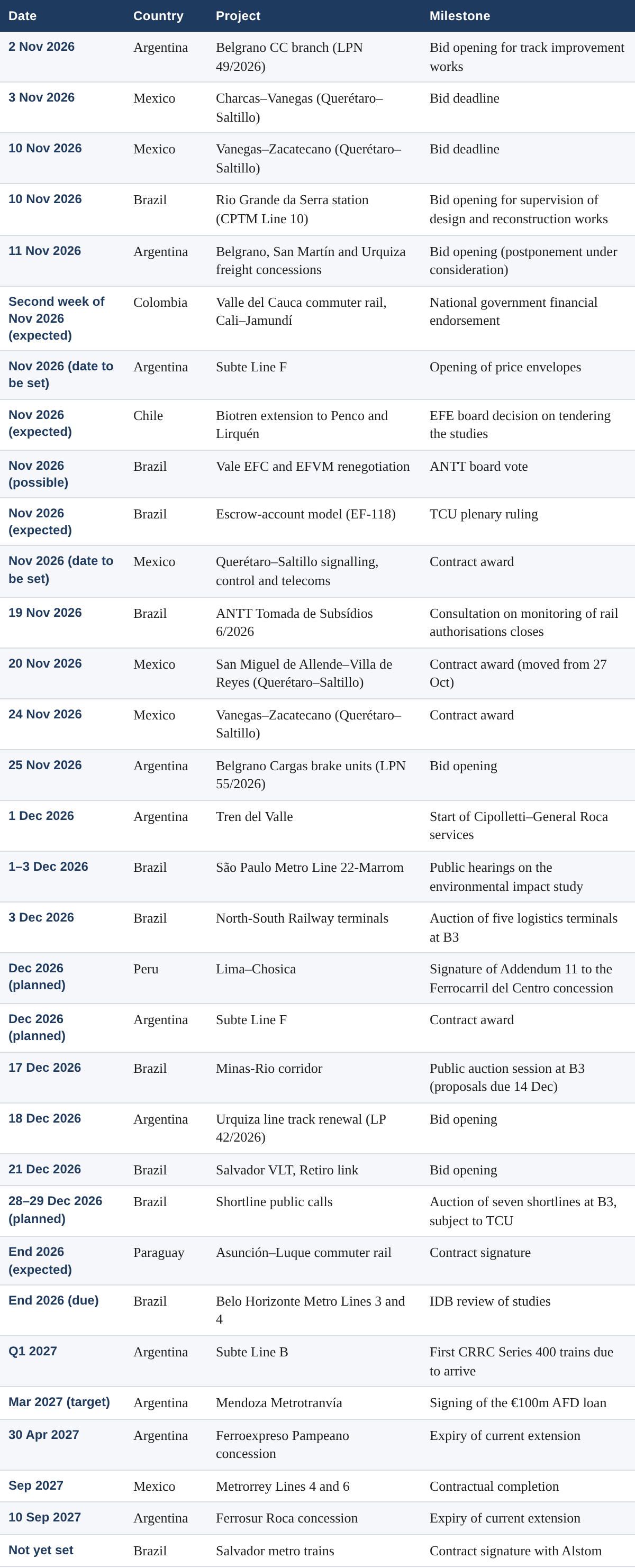
Entries from earlier issues are carried forward until they pass.
About this briefing
Latin American Rail Weekly is published free each week by Latin Rail Intelligence. Organisations that require coverage focused on their own markets, products or competitors can arrange tailored monitoring with us. Enquiries are welcome: andrew.young@latinrailintelligence.com.