

Weekly intelligence on rail projects, tenders, concessions and policy across Latin America, from Latin Rail Intelligence.
Covering news from 12 to 17 October 2026
Forwarded this issue? Latin American Rail Weekly is free each week: subscribe here
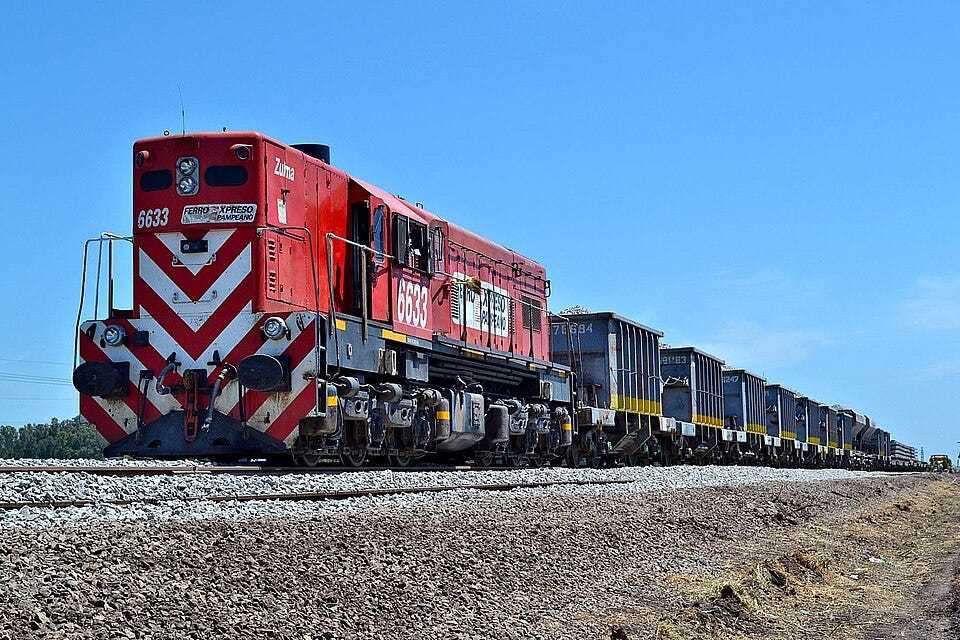
Photo: Juan Enrique Gilardi / Wikimedia Commons (CC BY-SA 2.0)
This week
Argentina’s freight concessions led the week. The government intends to re-tender the Ferroexpreso Pampeano and Ferrosur Roca concessions rather than extend them again, with Vaca Muerta traffic as the driver. The province of Salta, in the mining north-west on the borders with Chile and Bolivia, pressed for mandatory branch-line investment in the Belgrano Cargas concessions, four weeks before bids open. In Mexico, two further construction lots on the Querétaro–Saltillo section of the Mexico City–Nuevo Laredo corridor, covering 150 km, are heading for November bid deadlines. In Buenos Aires, five consortia bid for track renewal on the San Martín line between Caseros and Pilar. Shorter items from Brazil, Argentina, Chile, Paraguay and Peru follow under Also this week.
Each item gives the facts, then a short assessment of what it means for the supply chain and investors. Exchange rates are unchanged from last week: Brazilian values at approximately R$5.11 per US dollar, the average PTAX rate for September 2026 (numerando); Mexican values at 18.28 pesos per US dollar, the Banxico FIX rate on 2 October 2026 (Líder Empresarial); Argentine values at 1,542 pesos per US dollar, the wholesale rate on 8 October 2026 (El Cronista).
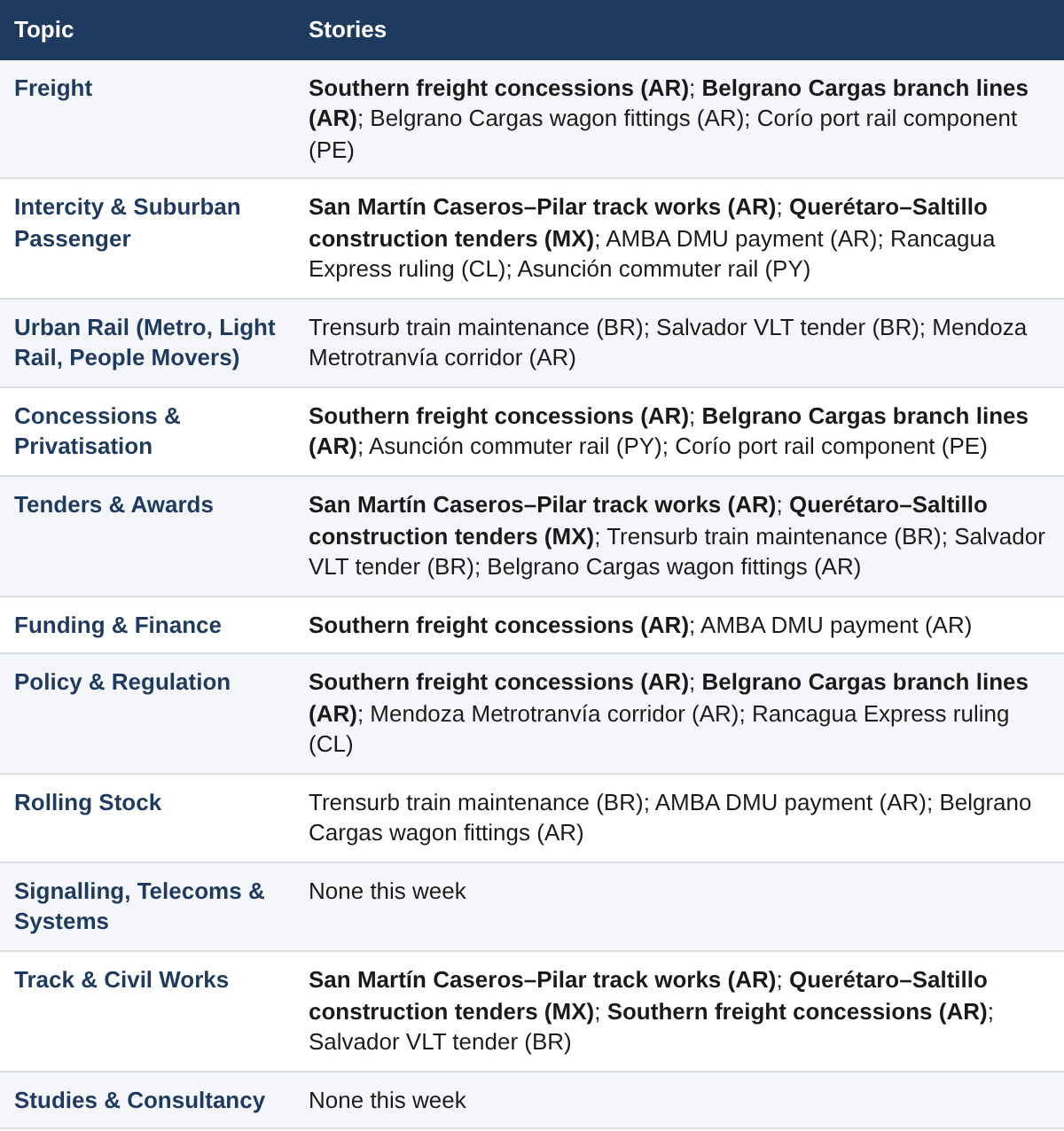
Stories by topic
Every story in this issue, listed under each topic it touches. Main items are in bold; the rest appear under Also this week.
Argentina: Southern freight concessions to be re-tendered, with Vaca Muerta as the driver
Argentina’s government intends to re-tender the freight concessions held by Ferroexpreso Pampeano (FEPSA, controlled by Techint) and Ferrosur Roca (controlled by Loma Negra) rather than extend them again. According to government sources cited by the Bahía Blanca newspaper La Nueva, the two will be run as separate processes, most of the investment is expected to come from the private sector, and the tender documents are still being prepared (Transporte y Energía).
Both concessions now run on precarious, revocable extensions. Resolution 549/2026 extends FEPSA’s Rosario–Bahía Blanca concession to 30 April 2027 and orders a new public-private framework; it cites rising rail traffic of sand, equipment and supplies for Vaca Muerta and the need for significant investment to raise capacity (Ministry of Economy). Resolution 1498/2026 extends Ferrosur’s concession on the broad-gauge Roca network to 10 September 2027 and names the Belgrano Cargas tender as the model for its next contract (iProfesional).
The government is also talking to the provinces about reviving the Norpatagónico line from Bahía Blanca to Añelo in the Vaca Muerta basin, which remains formally suspended. Its last official design covered 665 km: 208 km of track renewal, 374 km of improvement and about 83 km of new line into Añelo (NoticiasNQN). The plans are being aligned with the Andes–Atlántico Corridor launched with the United States on 23 September, under which EXIM has a framework for up to US$7bn of financing by 2027; no sum has yet been earmarked for rail (Enerdata).
What it means. Three of Argentina’s freight networks could come to market within about a year: the Belgrano, San Martín and Urquiza lines, already out to tender with bids due on 11 November, then FEPSA and Ferrosur. Vaca Muerta frac sand, pipe and drilling equipment is the growth case, and the government’s own resolutions point to capacity investment, which means track renewal, rolling stock and signalling demand once new contracts are let. Concession length, investment obligations and open-access terms are not yet known, and will decide whether operators and lenders commit.
Argentina: Salta presses for mandatory branch-line works in the Belgrano Cargas concessions
Gustavo Sáenz, governor of Salta, a north-western province bordering Chile, Bolivia and Paraguay whose Puna highlands host lithium and copper projects and whose lowlands produce grain, is backed by seven provincial business chambers. He wants rehabilitation of the C14 and C15 branches of the metre-gauge Belgrano network made mandatory in the 50-year concessions for the Belgrano, San Martín and Urquiza lines, for which bids open on 11 November (Perfil). Under the tender documents, mandatory works must be completed in the first five years and may draw on a trust fund of up to US$78.5m on the Belgrano line; according to Salta senator Flavia Royón, none of the eight mandatory works is on either branch (Transporte y Energía, from Clarín).
The 553 km C14 runs from Salta to Socompa on the Chilean border, where it meets the Chilean network to the port of Antofagasta, giving Puna mining projects a rail route to the Pacific; the province puts its rehabilitation at about US$80m. The C15’s 334 km Pichanal–Salvador Mazza section towards Bolivia is out of service, and Salta estimates its recovery at about US$90m. On 15 October the Ministry of Economy said it will convene mining companies and logistics operators to examine capacity on the C14, and will seek private investment funds to reopen the C15, without affecting the fiscal balance. It announced no change to the tender documents (Infobae; Tendencia de Noticias).
What it means. The scope appears fixed for the 11 November bid opening, but pressure on investment obligations is rising and could return after award. For mining companies in the Puna, the C14 is the most direct rail route to Pacific ports, and a model in which shippers co-invest alongside the concessionaire now looks the most likely way it is upgraded. The C15, serving many smaller agricultural producers, is harder to finance on that basis.
Mexico: Next two Querétaro–Saltillo lots head for November bids
The Agency for Trains and Integrated Public Transport (ATTRAPI) has updated the timetable for the next two construction lots on the San Luis Potosí–Saltillo stretch of the Querétaro–Saltillo section. A revision posted on 8 October to Proyectos México, the federal government’s project platform, sets bid deadlines of 3 November for the 57 km Charcas–Vanegas lot and 10 November for the 93 km Vanegas–Zacatecano lot (Info7). The Vanegas–Zacatecano tender (LO-09-JZO-009JZO001-I-59-2026), first published on 11 September, had its clarification meeting suspended and then held on 13 October. Its record on ComprasMX, the federal e-procurement platform, schedules the award for 24 November and the start of works for 25 November, over 1,003 days. It is an international open tender with joint bids allowed, a lump-sum design-and-build contract and a 30% advance; subcontracting is limited to quality control.
Together the two lots cover about 45% of the 334.3 km San Luis Potosí–Saltillo stretch, estimated at 109bn pesos (US$5.96bn). They follow the award of the first construction contract on the section, Querétaro–San Miguel de Allende, to a Mota-Engil consortium for 22.4bn pesos (US$1.23bn), reported in last week’s issue.
What it means. Two points matter for international contractors. The tender is open to foreign bidders and allows joint bids, so there is room beyond the established leaders. But subcontracting is restricted to quality control, so a partner must be inside the bidding consortium rather than a subcontractor to it. The lots are dominated by structures, viaducts, bridges and rail over- and underpasses; track, systems, power and rolling stock are likely to follow as separate packages.
Argentina: Five consortia bid for San Martín track renewal between Caseros and Pilar
Trenes Argentinos Infraestructura (ADIF) has opened the technical envelopes for renewal and improvement of about 60 km of track on the San Martín line between Caseros and Pilar, tendered in June. Five bidders took part: UTE ADIF San Martín (Zonis and Concret Nor); UTE C&E Construcciones, Semisa Infraestructura and Ingeniería Prida Hilbing; UTE Mercovial, Pose and Pietroboni; Copimex, for the second lot only; and BTU (enelSubte).
The first lot covers 16 km of renewal and 14 km of improvement between Caseros and José C. Paz, with turnouts, 31 level crossings and eight structures; the second covers 15 km of renewal and 15 km of improvement between Bella Vista and Pilar, with level and pedestrian crossings and five structures. The work uses concrete sleepers and continuous welded rail over 730 days, with the turnouts bought under a separate contract. Price envelopes will be opened in the coming weeks.
What it means. With the IDB-funded Retiro–Pilar modernisation and electrification cancelled, ADIF is renewing the San Martín in nationally funded packages: this tender and the Retiro–Palermo signalling and track works, which drew two bidders last week. The field is Argentine civil contractors; suppliers of concrete sleepers, rail, fastenings and turnouts will find their opportunities through these consortia.
Also this week
Brazil
Trensurb has suspended its tender for engineering maintenance of 40 trains (25 Series 100 and 15 Series 200) on the Porto Alegre metropolitan line to rule on a legal challenge, and has meanwhile made a R$6.92m (US$1.35m) emergency direct award to Sepsamedha Brasil and ALT & Railteco Rail, which will form a special purpose company to carry out the work (Diário do Transporte, suspension; Diário do Transporte, emergency award).
The Bahia State Transport Company (CTB) has moved the bid opening for the 3.75 km Salvador VLT segment linking Santa Luzia and Baixa do Fiscal to Retiro metro station, a design-and-build contract, from 8 October to 21 December (Diário do Transporte).
Argentina
The Ministry of Economy has approved, by Resolution 1807/2026, an agreement giving Mendoza free use of the national network sections used by its Metrotranvía, between Mendoza Central, Panquehua and Espejo, with the province responsible for their maintenance (Crónica Ferroviaria).
Trenes Argentinos has made the first contractual payment on its order for 43 DMUs (150 cars) from CRRC Tangshan and CRIIC for the Buenos Aires suburban network, now stated at US$324m; the first trains are due at the end of 2027 (Trenes Argentinos).
Belgrano Cargas y Logística has tendered the fitting of locks and chain hooks to wagons (LPN 53/2026), estimated at ARS266.6m (US$0.17m) plus VAT, with bids due on 28 October (tender notice).
Chile
Chile’s Second Environmental Court has ordered the state railway company, Empresa de los Ferrocarriles del Estado (EFE), to seek a review of the environmental approval for its Santiago–Rancagua upgrade. This is the project behind the Rancagua Express, an 81.8 km electrified commuter service opened in 2017 that carried 7.8 million passengers in 2023 (Railway Gazette; BioBioChile). The court found that operational noise had not been assessed against the correct standard, but declined to annul the permit because suspending the service would cause greater harm (ruling of 9 October in case R-444-2024; El Rancagüino).
Paraguay
The Ministry of Public Works expects to sign the contract for the Asunción–Luque commuter railway, to be built and operated for 30 years by a company owned 75% by Etihad Rail, the UAE’s national railway company, and 25% by Ferrocarriles del Paraguay (Fepasa), Paraguay’s state railway company, at the end of 2026, with early works in the first half of 2027; the 18 km double-track electric line has an estimated cost of US$450m (Agencia IP).
Peru
ProInversión, Peru’s investment promotion agency, and the Arequipa regional government are promoting a new deep-water port at Corío in southern Peru, estimated at US$844.5m in three phases; the second phase, at US$109.3m, includes a bulk berth, storage and a rail component, and the regional governor has said the port would probably be developed as a public-private partnership (El Peruano; Mundo Marítimo).
Dates to watch
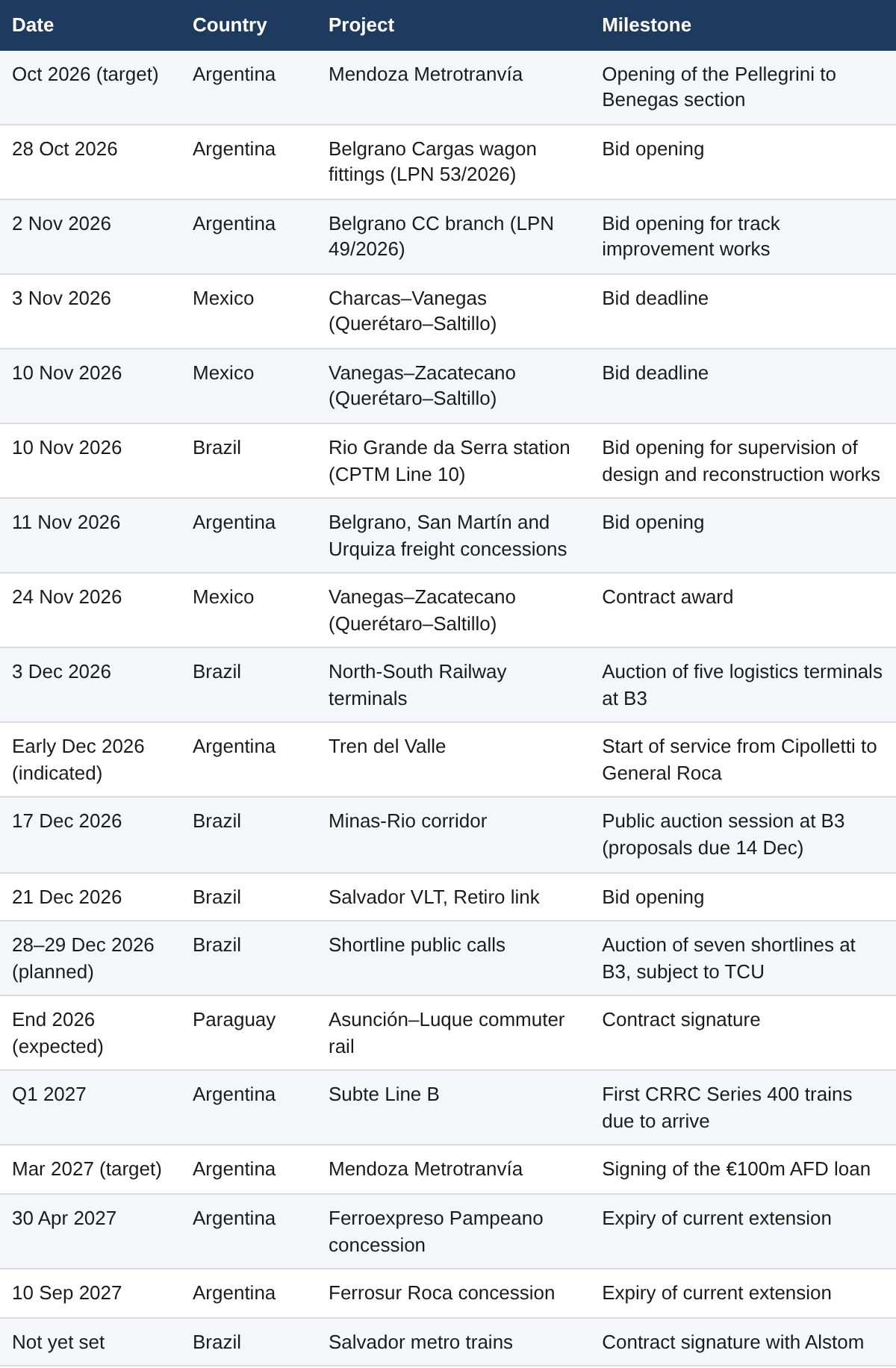
The October target for Mendoza, the 2 and 10 November (Rio Grande da Serra), December, Q1 2027, March 2027 and Salvador metro entries are carried forward from earlier issues.
About this briefing
Latin American Rail Weekly is published free each week by Latin Rail Intelligence. Past issues are available at weekly.latinrailintelligence.com. Organisations that require coverage focused on their own markets, products or competitors can arrange tailored monitoring with us. Enquiries are welcome: andrew.young@latinrailintelligence.com.
Sources
Southern freight concessions: Transporte y Energía (La Nueva); Resolution 549/2026; iProfesional (FEPSA); iProfesional (Ferrosur); NoticiasNQN; Enerdata; Forbes Argentina
Belgrano Cargas branch lines: Perfil; Transporte y Energía (Clarín); Infobae; El Tribuno; Tendencia de Noticias; Mundo Marítimo (C14 to Antofagasta)
Querétaro–Saltillo: ComprasMX, the federal e-procurement platform, procedure LO-09-JZO-009JZO001-I-59-2026 (file E-2026-00095188); Info7; Milenio
San Martín Caseros–Pilar: enelSubte; enelSubte (Retiro–Palermo)
Also this week: sources linked in each item
Exchange rates: numerando, USD/BRL PTAX 2026; Líder Empresarial, Banxico FIX 2 October 2026; El Cronista, wholesale rate 8 October 2026