

Weekly intelligence on rail projects, tenders, concessions and policy across Latin America, from Latin Rail Intelligence.
Covering news from 9 to 14 November 2026
Forwarded this issue? Latin American Rail Weekly is free each week: subscribe here
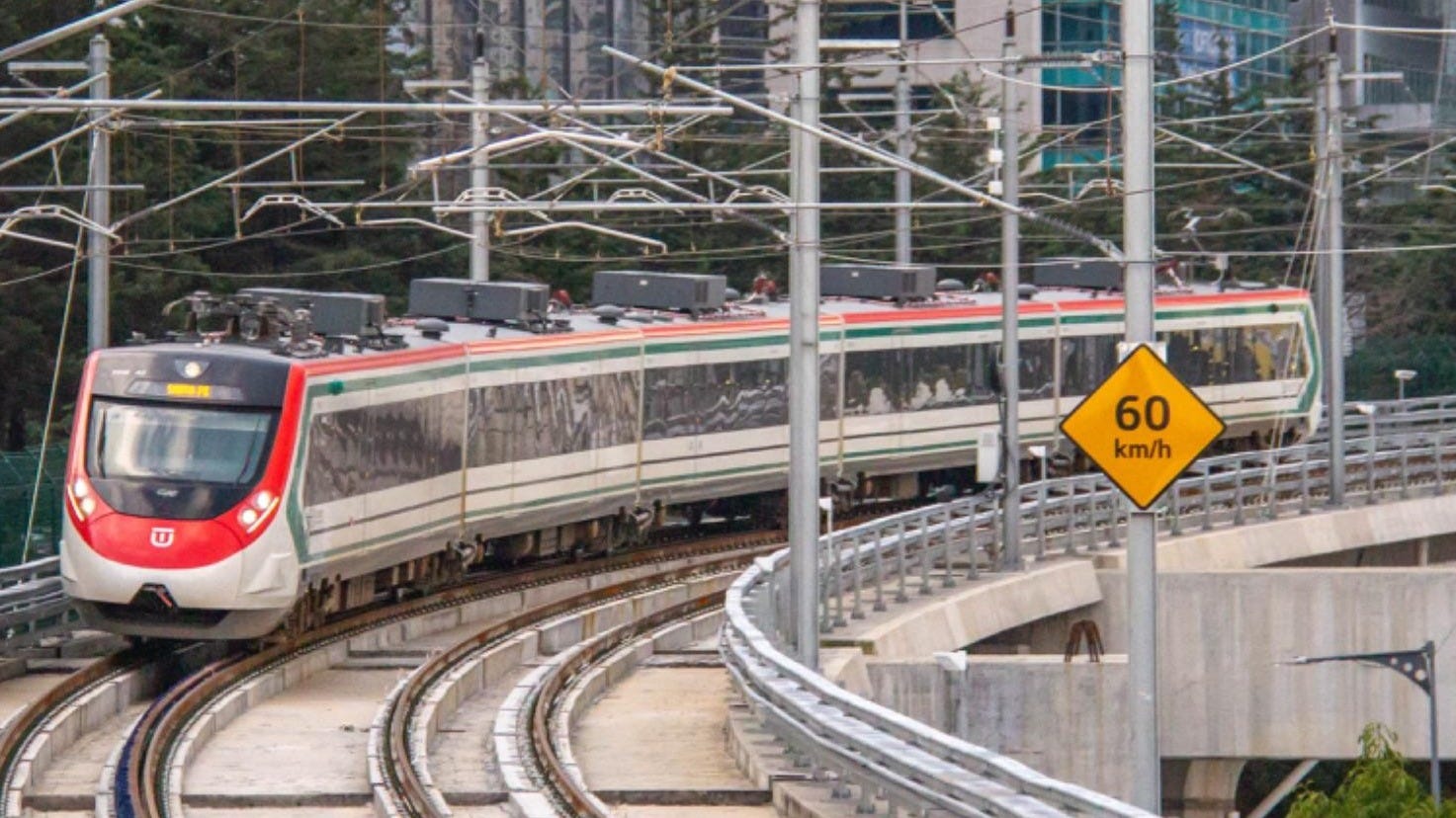
Photo: Government of Mexico / ATTRAPI
This week
In Mexico, ATTRAPI has launched a tender for 52 passenger trains under a new investment law that allows private finance. In Brazil, a private company has asked ANTT for a 99-year authorisation to build a 155 km passenger railway between Brasília and Goiânia. In Argentina, the overhaul of 117 San Martín line coaches has been awarded to two domestic workshops. Costa Rica has issued the first tender for the Tibi electric train, and Metro de Panamá has tendered a US$190m, ten-year fare collection contract. Shorter items from Brazil, Chile, Colombia, the Dominican Republic, Guatemala, Mexico and regional lenders follow under Also this week.
Each item gives the facts, then a short assessment of what it means for the supply chain and investors. Exchange rates: Brazilian values at approximately R$5.11 per US dollar, the average PTAX rate for September 2026 (numerando); Mexican values at 18.28 pesos per US dollar, the Banxico FIX rate on 2 October 2026 (Líder Empresarial); Costa Rican, Guatemalan and Panamanian values in US dollars as reported by the sources.
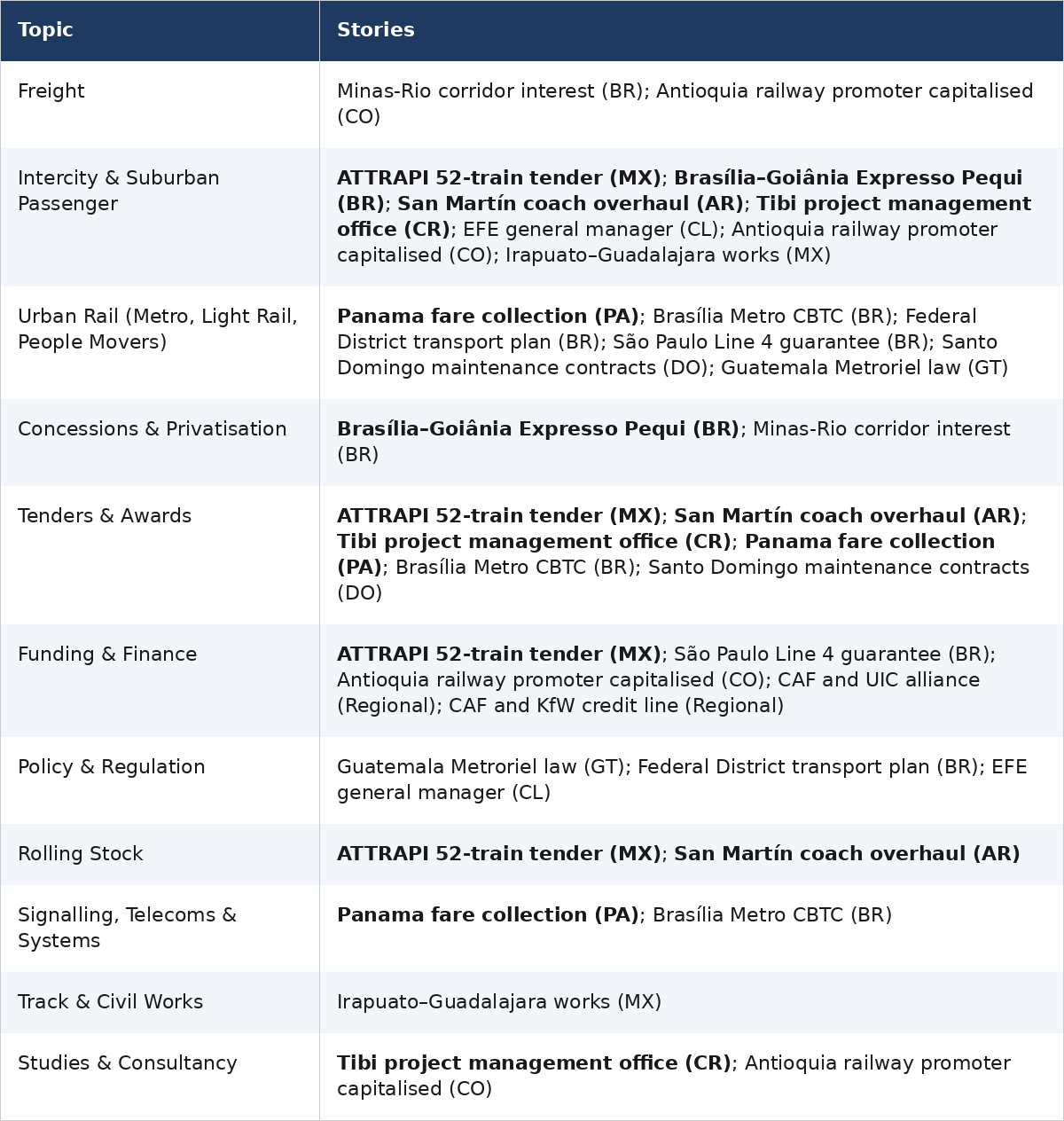
Stories by topic
Every story in this issue, listed under each topic it touches. Main items are in bold; the rest appear under Also this week.
Mexico: ATTRAPI tenders 52 passenger trains under new investment law
The Agency for Trains and Integrated Public Transport (ATTRAPI) published on 10 November an international tender for 52 passenger trains, 27 long-distance and 25 short-distance, for the Mexico City–Nuevo Laredo and Mexico City–Guadalajara corridors, where works on the Irapuato–Guadalajara section are due to start in December (see Also this week). The scope includes commissioning, maintenance and workshop equipment, under a contract running to 31 December 2034. The award is scheduled for 8 January 2027, though the date may move, and no value has been published (El Economista via Yahoo; Energy Magazine). Unlike the 2025 orders for 47 diesel multiple units (Alstom) and 15 electric multiple units (CRRC), about MXN26bn (US$1.42bn) paid from the federal budget, this purchase is let under the new strategic infrastructure investment law (LFIIEDB). Payment may come from public, private or mixed sources, the contractor may securitise its collection rights through a trust, and ATTRAPI will pay a 20% advance on each year’s amount.
What it means. This is Mexico’s largest train order since Alstom’s 47-train contract, and the first under a framework that lets private finance carry part of the cost. Manufacturers will need financing partners as well as depot and maintenance capability through 2034, and banks and investors gain a route into the programme through securitised payment rights. The award date is provisional and may slip given the novelty of the law.
Brazil: Private passenger railway proposed for Brasília–Goiânia
On 10 November ANTT published in the Official Gazette an extract of Ferrovia Brasil Central’s request for a 99-year authorisation to build and operate the Expresso Pequi, a 154.8 km electrified, double-track passenger line from Samambaia (Federal District) to Goiânia via Anápolis, with no public money. The company proposes six stations, speeds of up to 250 km/h, a journey of about 70 minutes, a fare of around R$150 (US$29) and a connection with the Brasília metro at the planned station 36 (Correio da Manhã; Mais Goiás). Its timetable foresees a preliminary environmental licence by 2029, an installation licence in 2031, construction from 2033 and passengers from 2036 (Click Petróleo e Gás). Little is publicly known about the company: its shareholders, its track record and the investment required have not been disclosed.
What it means. It tests whether the 2021 rail authorisation regime can deliver intercity passenger rail on a fully private basis. Publication opens ANTT’s review, not construction: electrification, signalling and high-speed rolling stock packages would follow only once financing and licences are in place. Watch also the Federal District’s own transport plan hearing on 5 December (see Also this week), which will shape the metro and light rail network the line would feed.
Argentina: Overhaul of 117 San Martín coaches awarded
Trenes Argentinos Operaciones (SOFSA) has awarded the heavy, mid-life overhaul of 117 of the San Martín line’s 160 CSR Puzhen hauled coaches, including vans, with air conditioning added. Lot I (63 coaches) goes to UTE Benito Roggio Ferroindustrial–Emepa and lot II (54 coaches) to Materfer; Motora Argentina, the third bidder, was not selected. The contract was launched in April and no value has been published (enelSubte; Pilar de Todos). It runs alongside the reactivated 2018 maintenance contract with Motora. A recent National Audit Office report found almost a quarter of the line’s coaches and a third of its locomotives out of service; the overhaul of its 24 CSR SDD7 locomotives has still not begun.
What it means. Two domestic workshops share a sizeable fleet programme, adding a rolling stock strand to the track renewal, turnout and sleeper packages ADIF is already tendering for the line. Suppliers of air-conditioning units and overhaul components should approach both winners. The locomotives remain the gap in restoring the service.
Costa Rica: Incofer launches first tender for the Tibi electric train
The Costa Rican Railways Institute (Incofer) published on 10 November a tender for a project management office, estimated at US$14.77m over six years, to manage the design, construction, equipping and commissioning of Lines 1 and 2 of the Tibi electric passenger railway in San José’s Greater Metropolitan Area. The office will review existing studies and designs, update costs, prepare financing and procurement plans and run the procurement processes, under the rules of lenders CABEI and the European Investment Bank. Bids are due on 11 January 2027 (Monumental; La Nación). Hiring it is a condition of the first loan disbursement (El Financiero). The design and construction tender is expected next year. The US$800m first phase covers 52 km of double track, 26 new stations and 28 electric trains.
What it means. This is the gateway contract for the programme: the office will shape how the main works and rolling stock tenders are packaged and evaluated. For consultancies it is the opportunity now; for contractors and train suppliers, its appointment starts the clock on the larger procurements that follow.
Panama: Metro de Panamá tenders US$190m fare collection contract
Metro de Panamá has opened a tender for fare collection and financial administration of the integrated public transport system, an estimated US$190m over ten years. The new contract will replace the arrangement Sonda has held since 2011 and integrate Line 3 and the planned cable car. Economic bids are due on 28 December (Panamá América). In December 2025 the Cabinet approved a direct award to Sonda of about US$11.8m to keep fare collection, financial administration and validator maintenance running on Lines 1 and 2 while the tender was prepared (TVN; La Estrella). Sonda said in March that it would compete for the new contract (La Estrella).
What it means. A ten-year contract of this size sets the fare and payment platform for Panama’s metro and bus network as Line 3 and the cable car come on stream. For fare collection, ticketing and payment system suppliers it is a significant opening, but the incumbent has an installed base and has said it will bid, so challengers will need a clear migration case. Banks and payment processors should also follow it, given the stated move towards fully electronic fare payment.
Also this week
Brazil
The Ministry of Transport says at least 11 investors have shown interest in the 733 km Minas-Rio corridor, offered in two lots as a 99-year authorisation at B3 on 17 December. Folha de S.Paulo has reported CSN, MRS Logística, Concremat and Porto Seco Sul de Minas among those interested (BNamericas; Diário do Comércio).
Metrô-DF has moved to 25 November the bid session for CBTC signalling and train control across all of Brasília’s Line 1, including the Ceilândia and Samambaia extensions, with gradual cut-over over about six years (Diário do Transporte).
The Federal District will hold the hearing on its consolidated transport and mobility plan (PDTM) on 5 December. The plan presented in September includes metro Line 2 (79.8 km) and two light rail lines, airport–W3–Noroeste (22.4 km) and Taguatinga–Ceilândia (17.5 km), at R$29.2bn (US$5.7bn) over ten years (Diário do Transporte; SouBrasília).
The federal government has authorised a guarantee for a R$2.223bn (US$435m) Banco do Brasil loan to São Paulo state, funding its contribution to the PPP extending Metro Line 4-Amarela to Taboão da Serra (Diário do Transporte).
Chile
EFE has appointed Juan Carlos García-Huidobro, general manager of Ferronor for 14 years, as its general manager from 24 November. He will lead the Melipilla and Batuco lines under construction and a new freight model that aims to double rail freight volumes (EFE).
Colombia
The Antioquia Assembly has authorised the capitalisation of the Promotora Ferrocarril de Antioquia to fund the structuring of the 182.1 km Bello–Puerto Berrío multipurpose railway; the decision does not authorise works (El Colombiano).
Dominican Republic
OPRET has published four-year maintenance procedures for the Santo Domingo Metro and Teleférico, placed as exception procedures with the original suppliers, Alstom, Siemens, Hitachi, Sofratesa and Poma. The contracts pass to the new Metropolitan Transport Company (EMT) from 1 January 2027 (Diario Libre; Noticias SIN).
Guatemala
President Bernardo Arévalo has sanctioned Decree 24-2026, the Metroriel law, published on 11 November and in force eight days later. Fegua is the executing body under a special procurement regime; the Phase 0 study gives about 20.5 km at US$900m to US$970m (Diario de Centro América; La Voz de Guate).
Mexico
SICT says construction of the Irapuato–Guadalajara section of the Mexico City–Guadalajara corridor will start in December, after ATTRAPI signed a right-of-way agreement with Jalisco and its municipalities. The section will have seven stations in Jalisco; in September the President had said works would begin in 2027 (Almomento, SICT release; La Razón).
Regional
CAF and the International Union of Railways (UIC) have signed an alliance at COP31 to support project preparation, institutional strengthening and access to finance for rail in Latin America and the Caribbean (La Razón).
CAF and KfW, for Germany’s BMZ, have signed a €140m concessional credit line for sustainable urban mobility projects in the region (CAF).
Dates to watch
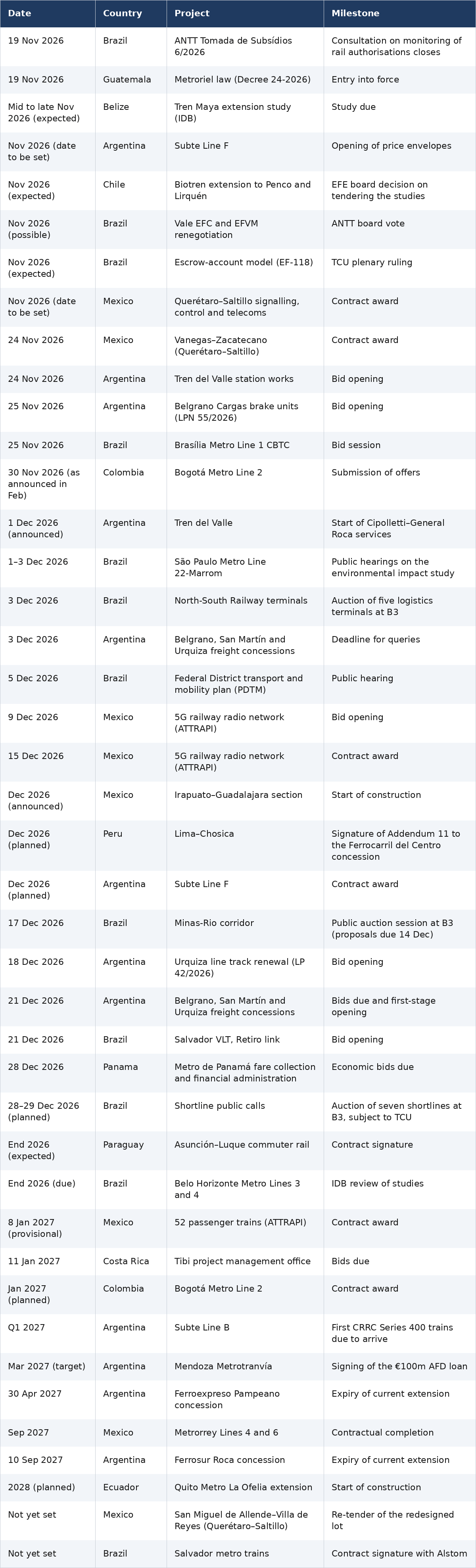
Entries from earlier issues are carried forward until they pass.
About this briefing
Latin American Rail Weekly is published free each week by Latin Rail Intelligence. Organisations that require coverage focused on their own markets, products or competitors can arrange tailored monitoring with us. Enquiries are welcome: andrew.young@latinrailintelligence.com.