

Weekly intelligence on rail projects, tenders, concessions and policy across Latin America, from Latin Rail Intelligence.
Covering news from 5 to 10 October 2026
Forwarded this issue? Latin American Rail Weekly is free each week: subscribe here
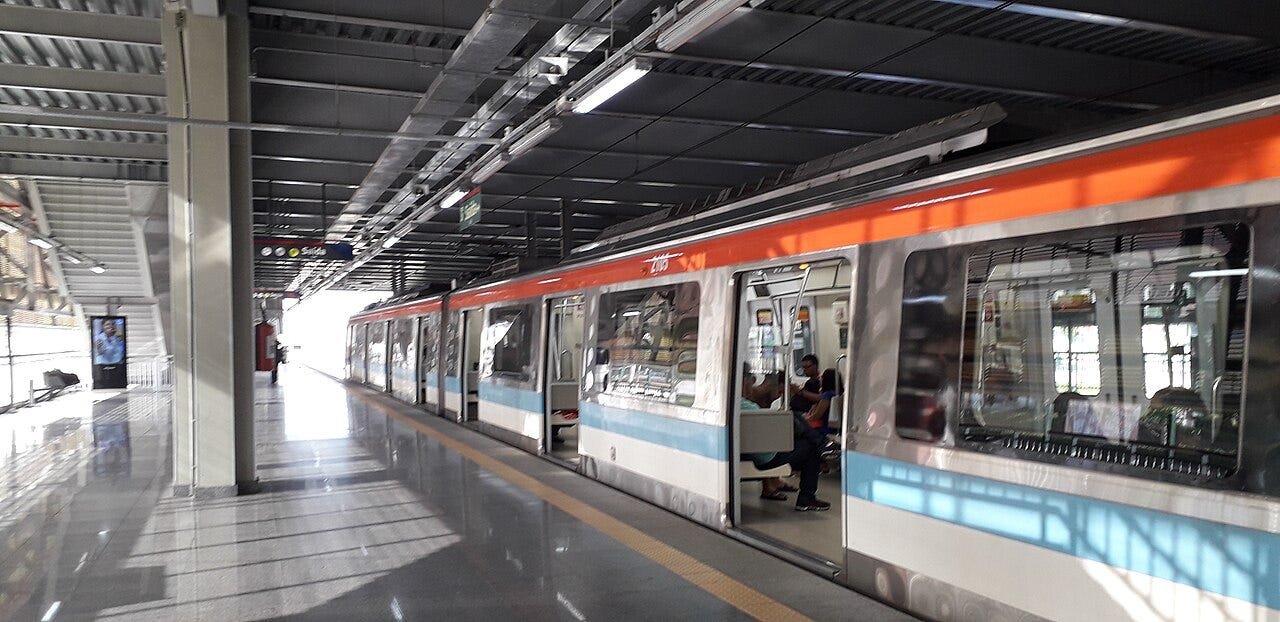
Photo: Ajmcbarreto / Wikimedia Commons (CC BY-SA 4.0)
_-_01.jpg)
This week
Rolling stock and finance led a week in which the news came from three of the region’s largest rail markets: Brazil, Argentina and Mexico. Latin American Rail Weekly covers the whole region, and other countries will feature whenever there is news to report. In Brazil, Alstom won the re-run tender for 10 Salvador metro trains after a contest with CRRC decided by local content rules, and MRS committed around US$254m to 50 Wabtec locomotives and their maintenance. In Argentina, CAF approved US$145m for the Buenos Aires Subte Line B modernisation, whose main contracts are already let, and Mendoza set March for a €100m loan from the French development agency AFD to complete its Metrotranvía. In Mexico, a Mota-Engil consortium won the first construction contract on the Querétaro–Saltillo passenger railway, worth 22.4bn pesos. Shorter items follow under Also this week.
Each item gives the facts, then a short assessment of what it means for the supply chain and investors. Brazilian values are converted at approximately R$5.11 per US dollar, the average PTAX rate for September 2026 (numerando); Mexican values at 18.28 pesos per US dollar, the Banxico FIX rate on 2 October 2026 (Líder Empresarial); Argentine values at 1,542 pesos per US dollar, the wholesale rate on 8 October 2026 (El Cronista).
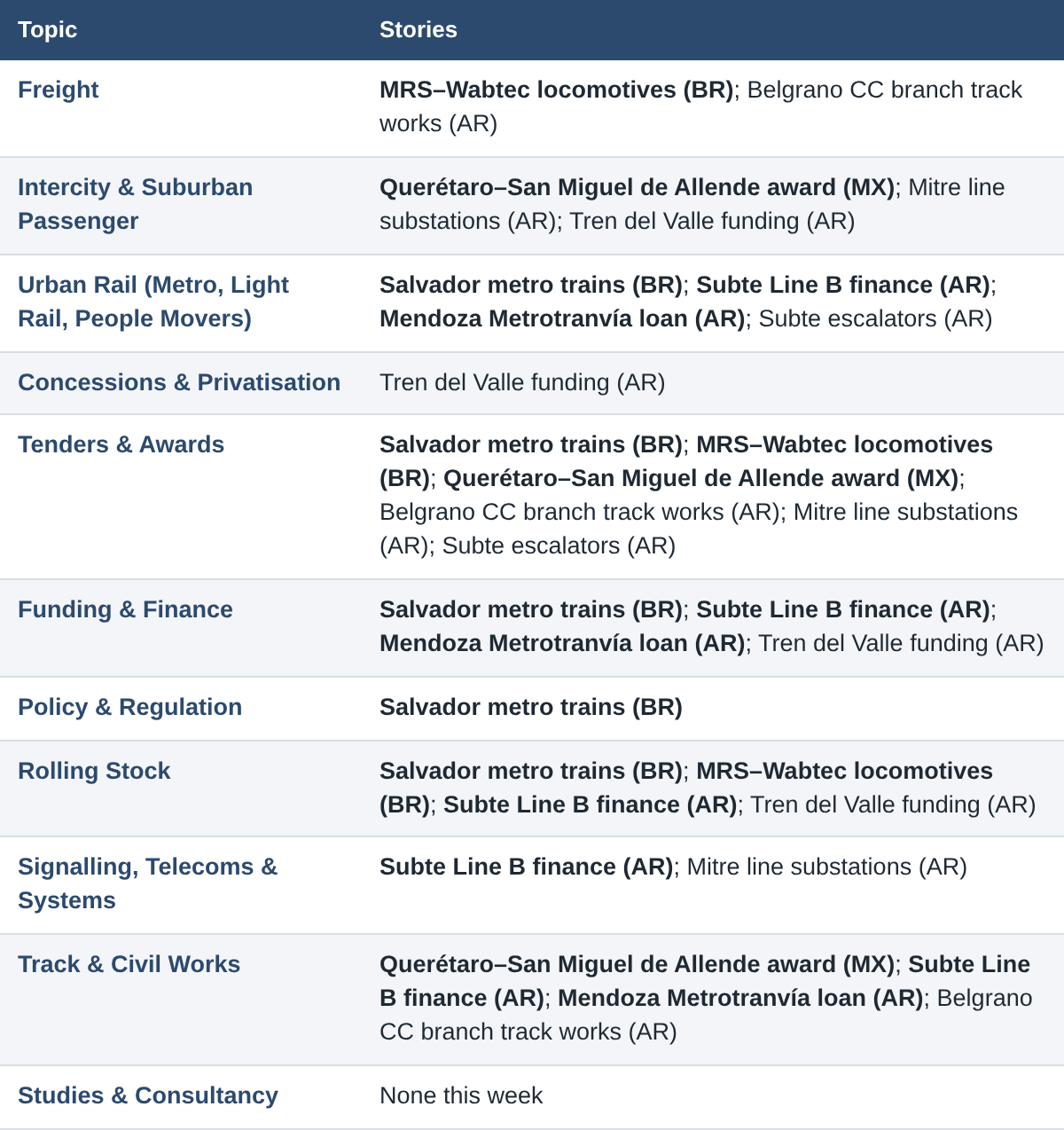
Stories by topic
Every story in this issue, listed under each topic it touches. Main items are in bold; the rest appear under Also this week.
Brazil: Alstom wins the re-run Salvador metro train tender
The Bahia State Transport Company (CTB) has declared an Alstom-led consortium the winner of its re-run tender for 10 four-car trains for Lines 1 and 2 of the Salvador and Lauro de Freitas metro, with a bid of R$632.7m (US$124m) against R$636.8m (US$125m) from CRRC Changchun. The result was published in the state official gazette on 22 September; the contract has not yet been signed (Movimento Econômico; Bnews).
In the first tender, CRRC bid R$490.4m against Alstom’s R$614.4m. CTB disqualified CRRC in June because it could not show accreditation under Finame, the equipment finance line of Brazil’s national development bank, BNDES. Finame funds only equipment accredited as meeting a minimum level of Brazilian-made content, and the tender required bidders’ trains to qualify. CRRC was reinstated on appeal, Alstom obtained an injunction blocking signature, and CTB revoked the tender in August and relaunched it (A Tarde; Agência iNFRA). In the second round CRRC raised its price by around 30% and said it will manufacture at the former Hyundai Rotem plant in Araraquara (SP) (Agência iNFRA). The purchase is financed by a R$616m Caixa Econômica Federal loan under the federal Novo PAC programme (Bahia Notícias).
What it means. Finame eligibility, not price, decided this contest. For any rolling stock supplier bidding for Brazilian urban fleets funded with federal money, local manufacturing or accreditation is now a qualification issue, and CRRC’s plan for Araraquara shows it intends to meet it. The state pays around R$142m more than CRRC’s first offer in return. Signalling and control for the Campo Grande extension remains the next Salvador package to watch.
Brazil: MRS commits US$254m to 50 Wabtec locomotives
MRS Logística has signed contracts with Wabtec Brasil worth around R$1.3bn (US$254m, the company’s figure) for 50 ES44 locomotives, spare parts, maintenance and other rolling stock services, with deliveries due by June 2032. MRS disclosed the agreement to the securities regulator (CVM) on 21 September, and Wabtec announced it on 23 September; neither has split the value between equipment and services (Atlas Público; Railway Age). The order follows 30 ES44ACi locomotives bought in February 2024 for around R$500m (Railway Supply). MRS operates a 1,643 km network in Minas Gerais, Rio de Janeiro and São Paulo.
The order adds to a run of Wabtec business in the region. In March 2025 Vale ordered 50 Evolution Series locomotives for its two railways: 36 eight-axle EVO units for the Vitória–Minas Railway and 14 ES58ACi units for the Carajás Railway, to be built at Wabtec’s plant in Contagem with deliveries from 2026 (IRJ). In June 2026, Wabtec agreed to bid jointly with Grupo México Transportes (GMXT) for Argentina’s Belgrano Cargas freight concession (Reuters via MarketScreener; IRJ).
What it means. Brazil’s renewed freight concessions carry fleet modernisation commitments, and they are now turning into multi-year orders. Bundling parts and maintenance into the supply contract to 2032 locks in a long service relationship, which makes an incumbent locomotive supplier harder to displace. For component and maintenance suppliers, the opportunity lies inside the OEM’s supply chain rather than in direct contracts with the operator. Wabtec’s position in Brazil rests on local production at Contagem; the Belgrano Cargas bid would take it in Argentina from supplier to bidder for an operating concession.
Argentina: CAF approves US$145m for Buenos Aires Subte Line B
The CAF board has approved a US$145m loan to the City of Buenos Aires, guaranteed by the national government, for the first stage of the Line B modernisation. The first stage costs US$241.7m, including US$96.7m from the city, and will be executed by Subterráneos de Buenos Aires (SBASE); a second stage of around US$183m could follow, subject to further CAF approval (Perfil; El Cronista).
Most of the first stage is already contracted (enelSubte):
29 six-car CRRC Changchun Series 400 trains, just over US$300m including taxes, contract signed; first arrivals in the first quarter of 2027.
CBTC resignalling for GoA2 operation, directly awarded to Zhuzhou CRRC Times Electric on standardisation grounds.
Conversion from 600V to 1,500V dc and eight rectifier substations, awarded to Zonis in May.
3,400 tonnes of 115RE rail bought from Hierro y Rueda.
Still to come are the renewal of 8.5 km of track between Alem and Federico Lacroze, not yet tendered, and Rancagua depot works, including an underfloor wheel lathe, now in tender.
What it means. The finance arrives after the main awards, so the remaining open packages are track renewal and depot works, plus whatever the second stage brings. The CBTC award matters beyond Buenos Aires: by giving the signalling to the train supplier without competition, SBASE has shown that winning a fleet can bring the systems work with it, which rival suppliers should factor into future rolling stock bids.
Argentina: Mendoza targets March for €100m AFD Metrotranvía loan
Mendoza expects to sign a €100m loan with the Agence Française de Développement (AFD) in March to complete the extension of its Metrotranvía, Finance Minister Víctor Fayad said when presenting the 2027 budget to the provincial legislature on 2 October. An AFD mission was due in the province the following week, and a national guarantee for the loan is included in the 2027 national budget bill (MNews; El Sol).
The province has been funding the works with US$100m advanced from its compensation (resarcimiento) fund, which the loan would reimburse. The extension is about 80% complete on average, and the Pellegrini to Benegas section is due to open in October. The northern branch to El Plumerillo airport is held up by right-of-way issues near Espejo station, which require an agreement with the national Transport Secretariat over the former San Martín railway land (MNews).
What it means. The loan refinances work largely under way rather than funding new packages, so near-term supply opportunities are limited to systems and finishing works on the remaining sections. The wider point is the source: a French bilateral lender financing an Argentine provincial rail project, with a national guarantee, widens the options for other provinces planning urban rail.
Mexico: Mota-Engil wins first Querétaro–Saltillo construction contract
The Agency for Trains and Integrated Public Transport (ATTRAPI) has awarded a consortium of Mota-Engil group companies, led by Mota-Engil México, a 22.4bn-peso (US$1.23bn) contract to design and build the first 68 km of the Querétaro–Saltillo passenger railway, from Querétaro to San Miguel de Allende. Six bids were received; ICA was runner-up at 23.7bn pesos (US$1.3bn), and other bidders included Omega Construcciones Industriales and Constructora de Proyectos Viales de México. The alignment is designed for 177 km/h, and work is due to start on 17 October with a 973-day construction period (T21; Poder México; La Región).
Querétaro–Saltillo will extend the Mexico City–Querétaro section north to Saltillo, where it meets the Saltillo–Nuevo Laredo section under construction, completing the corridor to the US border. The Finance Ministry estimates its cost at 312.8bn pesos (US$17.1bn) for 571.5 km, the most expensive of the five passenger rail projects launched under the current administration (Plano Informativo). Further construction sections towards San Luis Potosí are in tender.
What it means. This is the first of several civil works awards on the corridor, and the field is narrow: Mota-Engil is already building both sections of Querétaro–Irapuato, and the same handful of contractors is bidding each lot. International firms are most likely to win work as partners or specialist subcontractors to these groups. On Querétaro–Irapuato, trains and ERTMS signalling were procured separately from civil works, so systems, power and rolling stock packages should follow here.
Also this week
Argentina
Trenes Argentinos Cargas has tendered track improvement on the CC branch of the Belgrano line between Deán Funes, Recreo and Frías, covering sleeper replacement and about 5 km of rail renewal (LPN 49/2026). The estimated value is ARS6.76bn (US$4.4m) plus VAT, and bids open on 2 November (Crónica Ferroviaria).
The World Bank-financed Mitre line modernisation is moving on traction power: Trenes Argentinos Infraestructura (ADIF) has awarded renewal of the José León Suárez substation to Lesko (enelSubte), and has tendered a new 2 x 2,000 kW substation at Vicente López and upgrades of six substations on the Tigre branch (enelSubte).
Subterráneos de Buenos Aires has awarded the supply and installation of 41 escalators across Lines A to E, 20 for Line B to Ascensores Servas and 21 for the other lines to Femyp (enelSubte).
Río Negro has added ARS3.41bn (US$2.2m) to the budget of its provincial operator Tren Patagónico for train refurbishment and track, station and level crossing works, ahead of extending the Tren del Valle from Cipolletti to General Roca; the province has indicated a service start in early December (Crónica Ferroviaria).
Dates to watch
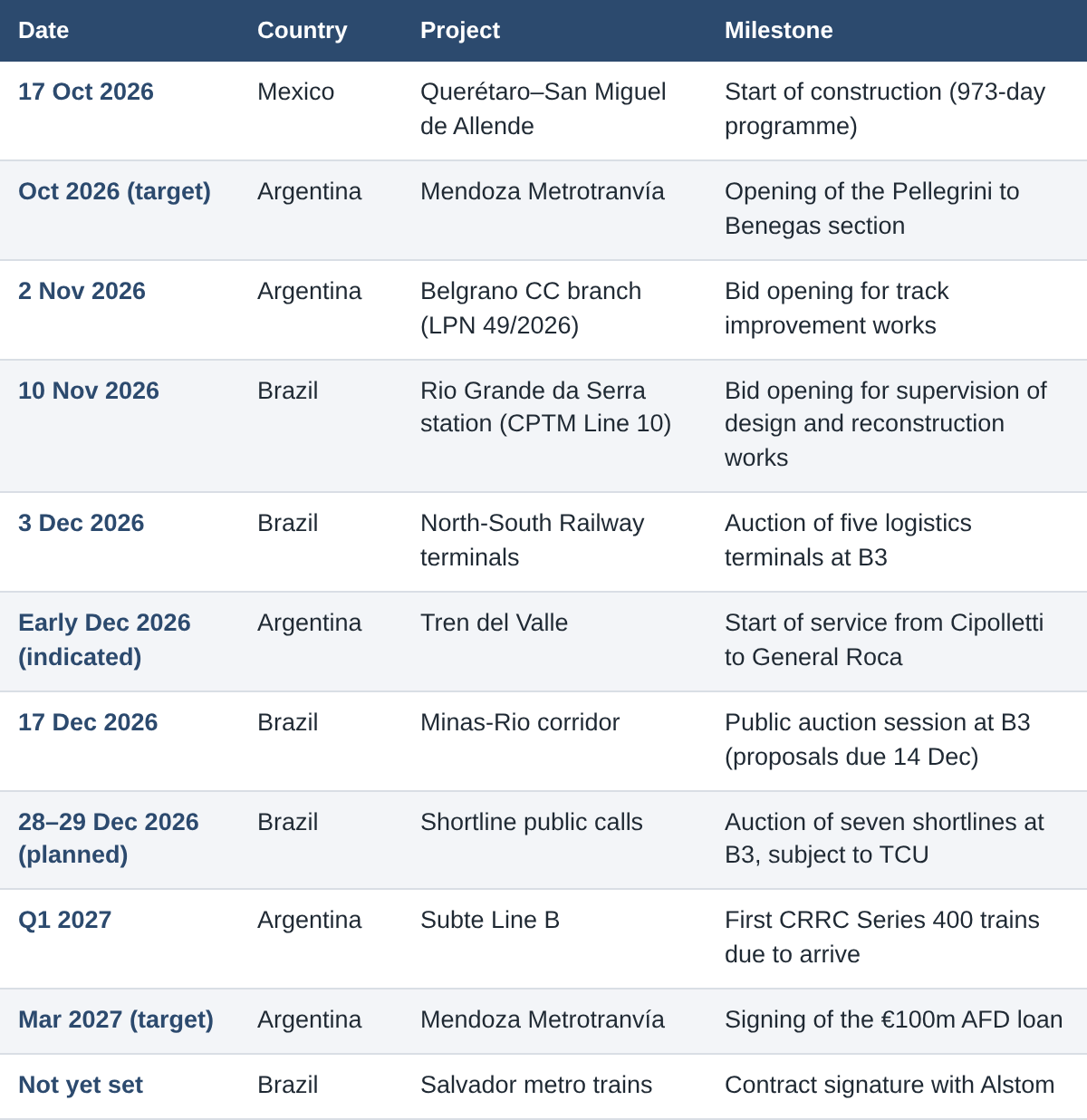
The 3, 17 and 28–29 December dates are carried forward from last week’s issue.
About this briefing
Latin American Rail Weekly is published free each week by Latin Rail Intelligence. Past issues are available at weekly.latinrailintelligence.com. Organisations that require coverage focused on their own markets, products or competitors can arrange tailored monitoring with us. Enquiries are welcome: andrew.young@latinrailintelligence.com.
Sources
Salvador metro trains: Movimento Econômico; Bnews; A Tarde (relaunch); A Tarde (revocation); Bahia Notícias (first award); Bahia Notícias (financing); Agência iNFRA
MRS–Wabtec: Atlas Público (MRS notice to CVM); Railway Age; Railway Supply; Diário do Comércio; IRJ (Vale order); Reuters via MarketScreener (GMXT and Wabtec); IRJ (Belgrano Cargas)
Subte Line B: Perfil; El Cronista; Bloomberg Línea; enelSubte
Mendoza Metrotranvía: MNews; El Sol; Los Andes
Querétaro–Saltillo: T21; Poder México; La Región; Milenio; Plano Informativo
Rio Grande da Serra (Dates to watch): Diário do Transporte
Also this week: sources linked in each item
Exchange rates: numerando, USD/BRL PTAX 2026; Líder Empresarial, Banxico FIX 2 October 2026; El Cronista, wholesale rate 8 October 2026